



WEST BLOOMFIELD — Millions of Americans live with sleep apnea and don't know it. If you snore, wake up tired, or fight fatigue through the day, you could be one of them.
For those who can't tolerate CPAP — the first-line treatment — Henry Ford Health is now offering a newer surgical implant called Genio.
See the full story in the video below
Jody DeLavern has been an avid cyclist for 29 years. But lately, fatigue has been getting in the way.
"Some days I don't wanna ride my bike because I'm too tired," DeLavern said.
The problem isn't her fitness. It's what happens when she sleeps. DeLavern has obstructive sleep apnea, a condition in which muscles in the tongue and throat relax enough to block the airway, interrupting breathing and compromising sleep.
"I have this little app that has like how bad you snore, and mine went to epic," DeLavern said.
She didn't initially realize what was happening.
"And I thought I was waking myself up because I was snoring real loud, but now I realize it's because I was gasping for air," DeLavern said.
Left untreated, sleep apnea can increase the risk of high blood pressure, cardiovascular disease, and stroke.
DeLavern tried CPAP — more than once.
"I just could not do it. I really really tried," DeLavern said.
The mask and hose made sleep more difficult, not less. So she went looking for another option and found one with Dr. Andrea Plawecki, an otolaryngologist and sleep medicine specialist at Henry Ford Health.
Plawecki implanted the Genio device through a single 2.5-inch incision under DeLavern's chin. The FDA approved the device about a year ago.
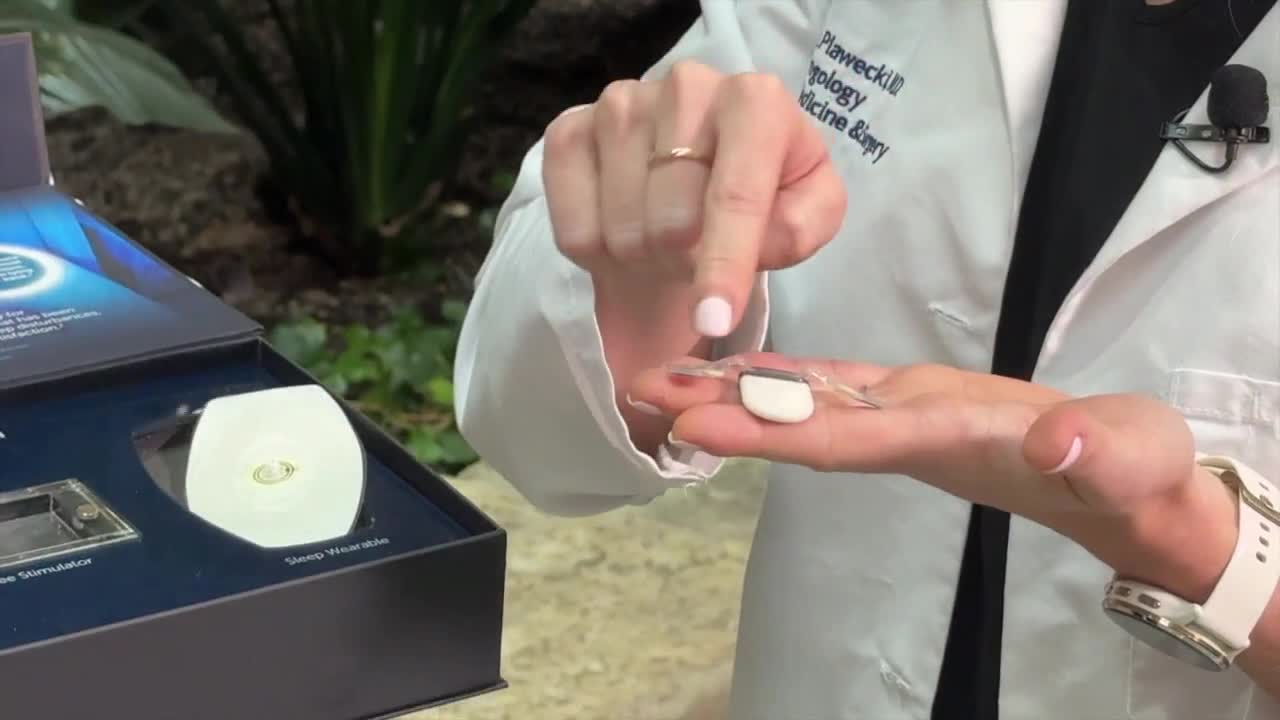
"This is what the implanted component looks like. And this part goes under the chin that sits over the parts of the nerve that control the muscles of the tongue and the airway," Plawecki said.
The device works by stimulating the nerves in the neck that control the muscles of the tongue and throat.
"It causes the muscles to stay open and keep the airway open during sleep," Plawecki said.
Before closing the incision, Plawecki tests the implant to confirm it is responding as intended. The stimulation causes the tongue to move forward, expanding the airway.
"So it's like a gentle stimulation, kind of like a pulse that's delivered to those muscles to keep them open, to basically keep them from collapsing," Plawecki said.
Unlike some implanted sleep apnea devices, Genio's battery is not placed inside the body. Instead, an external battery attached to a small disposable patch worn under the chin powers the device each night — eliminating the need for a later procedure to replace a dying battery. As a patient's needs change over time, doctors can also adjust the stimulation externally.
To use the device, patients apply the patch before bed.
"You take one of your disposable adhesive patches, attach the two, apply it, and then you're ready to go to sleep," Plawecki said.
The treatment is for patients who meet specific criteria, including having moderate to severe sleep apnea and being unable to tolerate CPAP.
For DeLavern, the goal goes beyond quieter nights.
"I'd like to be able to say that I'm sleeping well, that my head is clear," DeLavern said.
"So I'm hoping no more epic snoring," DeLavern said.
DeLavern completed two months of healing after surgery, and the implant was scheduled to be activated this week. From there, her care team can fine-tune the stimulation over time to find the settings that work best for her. We will follow up with DeLavern to see whether Genio translates into better sleep and more energy in the weeks ahead.
This story was reported on-air by a journalist and has been converted to this platform with the assistance of AI. Our editorial team verifies all reporting on all platforms for fairness and accuracy.
