



ANN ARBOR, Mich. (WXYZ) — The sudden death of U.S. Sen. Lindsey Graham this summer put aortic dissection in the national spotlight. Preliminary findings from the medical examiner showed the 71-year-old died after a tear in his aorta.
But doctors say the life-threatening emergency does not only affect older adults.
Jacob Connolly, a 28-year-old father from Swartz Creek, learned that firsthand after severe chest pain sent him to the hospital. Hours later, he was fighting for his life.
“The chest pain started. It was just a super strong pain right here, and it was like a pain every heartbeat,” Connolly said. “It came on very quickly.”
Connolly was at work in downtown Detroit when the pain began. He described it as some of the worst pain he had ever experienced.
Watch Keenan Smith's video report below:
“Like a nine or a 10. Like it was, it was very bad,” Connolly said.
Within minutes, he called 911.
Connolly said an EKG, chest X-ray and blood work at the first emergency room ruled out a heart attack. He said he was told the pain was likely anxiety.
After about five hours, he went home still in severe pain.
“One doctor had already told me I was good to go home. So when I hear that from a doctor, I believe them,” Connolly said.
But the emergency inside his chest was continuing to unfold.
Back home, Connolly wanted to stay in bed. His wife, Alison Connolly, believed something was still wrong. She and her cousin spent nearly two hours trying to convince him to seek a second opinion.
Then she said something that changed his mind.
“I'm gonna be exhausted if I have to plan another funeral. Like I can't, you can't die right now,” Alison Connolly said.
The comment carried special weight for the couple.
In 2023, they lost their son, Warren, when he was 5 weeks old.
“His name was Warren. He was a perfect little baby boy. He was born on Halloween in 2023,” Alison Connolly said.
Warren was born with tetralogy of Fallot, a complex congenital heart defect.
Now, Alison Connolly feared another cardiac tragedy could take away someone she loved.
“I kind of guilted him into going and thank God I did because he would have died,” she said.
At a second emergency room, a CT scan revealed the real problem: an aortic dissection.
Dr. Bo Yang, a cardiothoracic surgeon at University of Michigan Health, said an aortic dissection is a tear that causes the wall of the aorta, the body’s largest artery, to split into layers. A rupture can be fatal.
“It's like tearing pain inside, chest pain radiated to the back. It's very severe,” Yang said.
Yang said Jacob Connolly’s case was unusual because of his age.
“Jacob is a very, very interesting story because Jacob, he is so young,” Yang said. “Nobody thought he has a heart dissection.”
The report states that only about 7% of aortic dissections occur in people younger than 40.
Warning signs can include sudden, severe chest or upper-back pain, shortness of breath, dizziness and fainting. Some of those symptoms can overlap with a heart attack, making aortic dissection difficult to recognize.
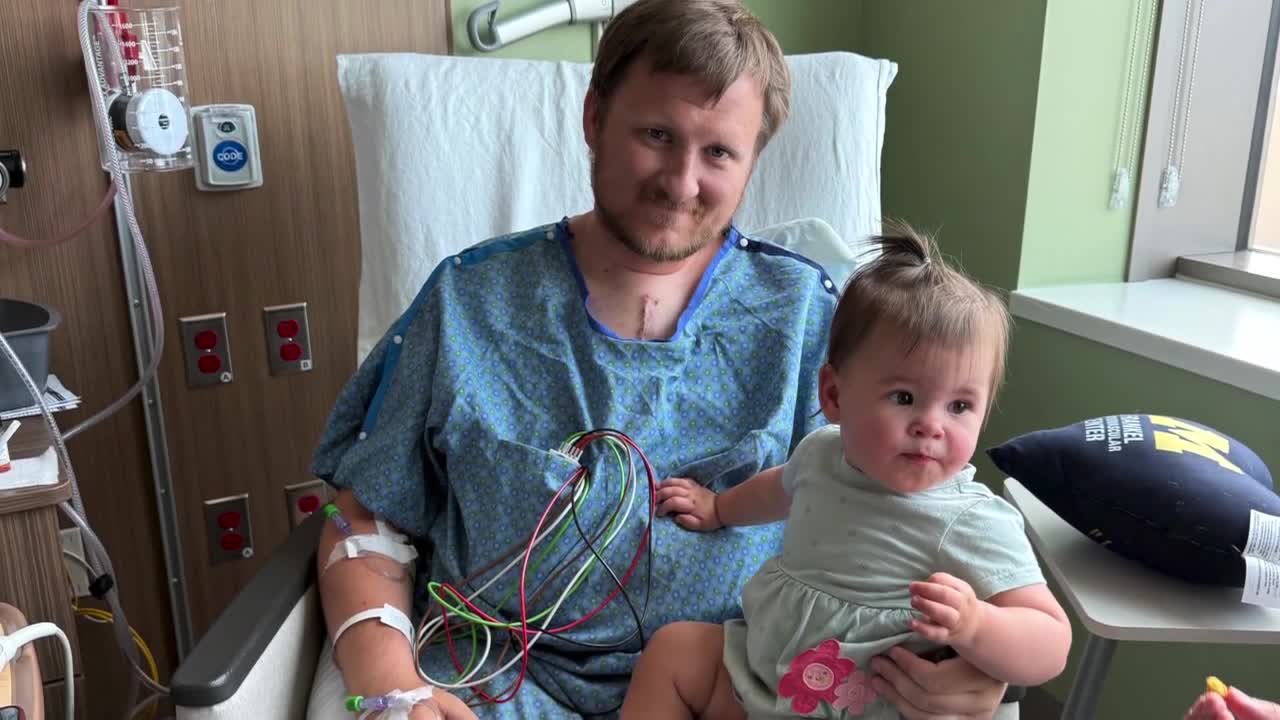
More than 12 hours after his symptoms began, Jacob Connolly was rushed to University of Michigan Health’s Frankel Cardiovascular Center for emergency surgery.
“Dr. Yang said that I probably only had, you know, minutes left,” Jacob Connolly said. “If I had waited another 15, 20 minutes, it might have been catastrophic."
Doctors say genetics can play an important role in younger patients.
For Jacob Connolly, there was a significant clue in his family history. His grandfather died from an aortic dissection. Now, family members are being screened, including younger relatives.
Today, Jacob Connolly is recovering. He is walking, preparing to begin light exercise and able to hold his daughter.
But Yang said he will need to carefully manage his cardiovascular health for the rest of his life.
“He needs to be very careful, you know, control the blood pressure, not smoking, don't do heavy lifting or strenuous exercise,” Yang said.
For Alison Connolly, watching her husband recover from open-heart surgery brought back memories of another hospital room and another loved one fighting for his life. This time, the outcome was different.
“I have been on my knees praying in a hospital bathroom more times than I feel is fair, but we did get a miracle with Jacob and I'm very happy about that,” she said.
Now, Jacob and Alison Connolly hope their experience encourages others to keep advocating for themselves when they feel something is wrong and the answers do not seem right.
They also want people to understand that severe chest pain should never be dismissed simply because someone is young.
The American Heart Association recommends screening for first-degree relatives — including parents, siblings and children — of people with this condition.
The couple also continues to honor Warren’s memory. Each October, they ask family and friends to donate items from a hospital wish list. Alison Connolly said they have filled an SUV with donations in each of the last three years.
—————
This story was reported on-air by a journalist and has been converted to this platform with the assistance of AI. Our editorial team verifies all reporting on all platforms for fairness and accuracy.
