

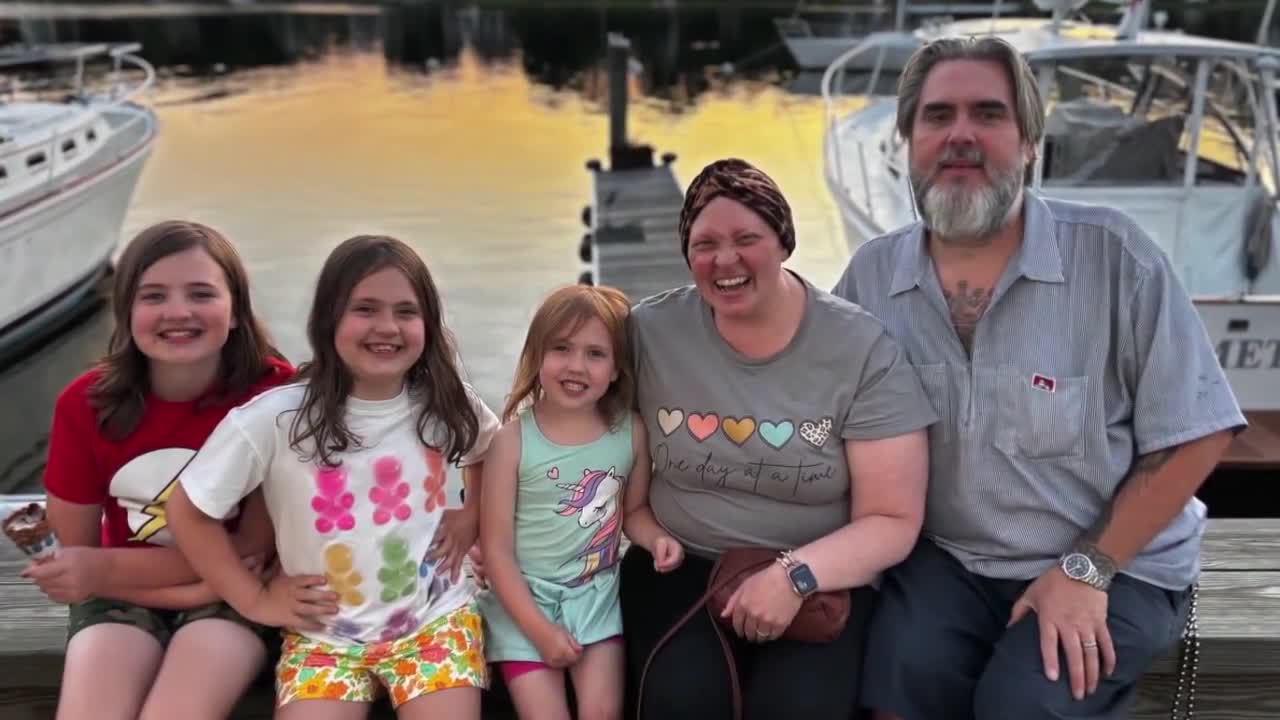


TRENTON, MI — At just 39, Erin Agy was diagnosed with one of the deadliest forms of cancer. A wife and mother of three young children, she suddenly found herself facing an uncertain future.
Now, a breakthrough medication is offering new hope in the fight against pancreatic cancer. I talked with Agy about her journey and a Henry Ford medical oncologist about a new treatment that could be a game changer.
See the full story in the video below
Michael is 11. Presley is 7. Celeste is 5. They are three reasons Agy keeps fighting.
"I love those kids more than anything. I think that's why I continue to be so strong and just keep fighting because I just wanna be around for every moment I can for them," Agy said.
The Trenton mom and Wyandotte High School counselor was just 39 last year when she learned she had stage 4 pancreatic cancer. The cancer had already spread to her liver.
"And anything I had ever heard about cancer, like stage four is the worst. And so that was really hard," Agy said.
With the diagnosis, Agy's biggest fear was the milestones she would miss watching with her husband, Mack — high school graduation and college commencement.
"I'm gonna miss all the big stuff. I'm going to miss my daughters getting married," Agy said.
"That was my first thought was that I was just going to miss everything," Agy said.
Her oldest son would eventually ask a question no mother wants to hear.
"And he asked, are you gonna die from this? And I said, honestly, I don't know. I said I'm doing everything I can to fight this and be around as long as I can," Agy said.
Agy endured chemotherapy and radiation. But when lesions in her liver grew, her doctors needed another option.
Then came daraxonrasib, sold as Rasonque, a pill FDA-approved in August for certain patients with metastatic pancreatic cancer.
"What it does is that it goes after a critical protein in the cancer cell and tries to paralyze that protein," said Dr. Philip Philip, co-leader of the pancreatic cancer program at Henry Ford Health.
The drug disrupts the growth and proliferation of cancer cells.
In a major trial, median survival was 13.2 months, nearly double the 6.7 months on standard chemotherapy. Rasonque also can reduce the size of tumors, and that can mean less pain. It's not a cure, but a new possibility for patients with few options.
"Oncologists, we'd like to change the tempo of the disease into a chronic disease where patients can have on treatment, continue on treatment for a long time," Philip said.
Agy was waiting to learn if she could get the new drug. Then, while buying supplies for her children, she received a call.
"I was in Walgreens picking up you know supplies for my kids and I'm in Walgreens and I am crying in Walgreen's," Agy said.
Agy has been taking Rasonque for nearly two months. Despite a difficult rash, she says markers her doctors are watching have been trending down. And now that she's off chemotherapy, her appetite is rebounding and her hair is growing.
"So I am growing hair like crazy. My hair is growing back. I finally have eyelashes again I'm so excited," Agy said.
Agy hopes that Rasonque will extend her life, not by months but by years.
The hope extends beyond pancreatic cancer. Henry Ford Health is now studying the same drug in clinical trials for certain patients with lung cancer. That use is still experimental.
But for Agy and thousands of other pancreatic cancer patients, the hope of more time is about the everyday milestones. Some, she's already reached.
"I got to see my daughter go to kindergarten, which I didn't think I was gonna see. I turned 40, which was huge," Agy said.
Agy just hit another milestone. She just turned 41.
Philip says this is just the beginning of what could be a new era in treating pancreatic cancer. He encourages patients to ask their oncologists about new targeted treatments or clinical trials.
You can donate to the GoFundMe supporting Erin here
This story was reported on-air by a journalist and has been converted to this platform with the assistance of AI. Our editorial team verifies all reporting on all platforms for fairness and accuracy.
