



(WXYZ) — In today’s Health Alert, a new executive order signed by President Donald Trump could speed up access to experimental treatments for serious mental illness. It focuses on psychedelic drugs that some say could help when other treatments haven’t.
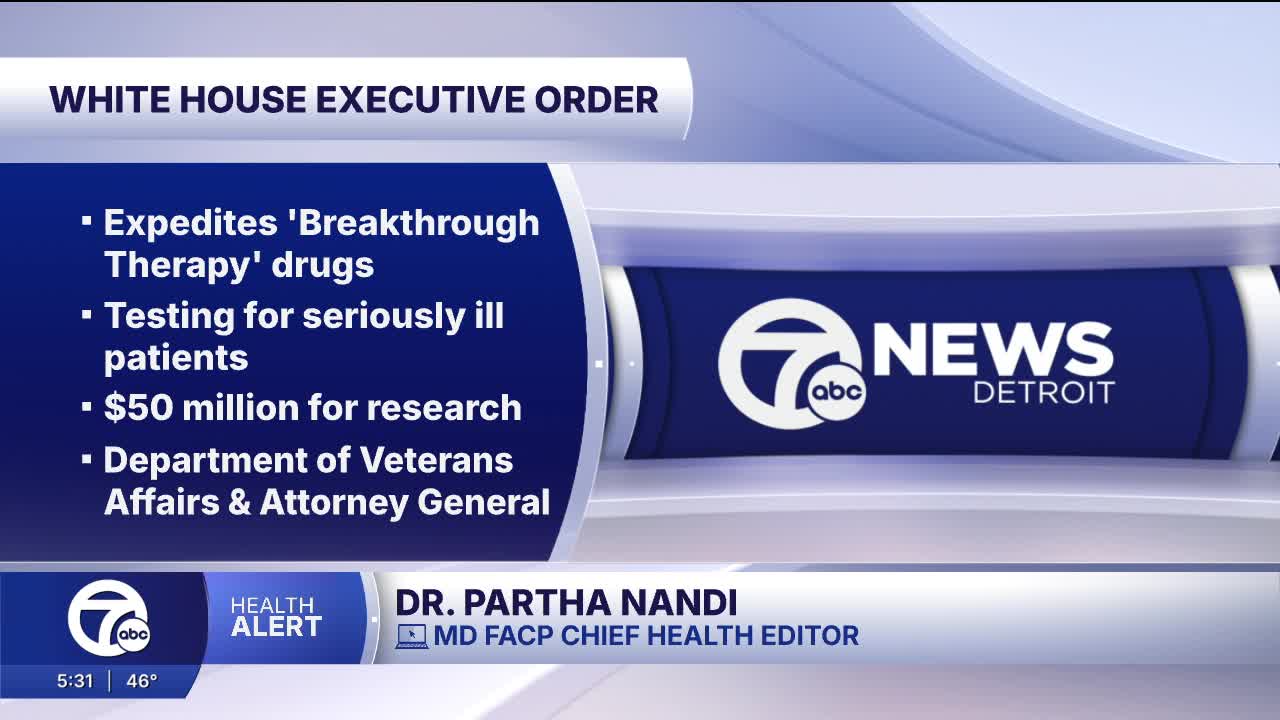
There are a few key parts to this executive order. First, it tells the Food and Drug Administration to prioritize certain psychedelic drugs that are already showing promise for serious mental illness. If a drug has “Breakthrough Therapy” status, it could qualify for special priority vouchers that help speed up the review process.
The order also directs the FDA and the Drug Enforcement Administration to create a pathway for some seriously ill patients to access investigational psychedelic drugs before they’re fully approved. That would be under the Right to Try Act, as long as basic standards are met.
There’s also a research push - about $50 million in federal funding to help support research and match state investments in studying these therapies.
The order also brings in the Department of Veterans Affairs. The goal is to increase participation in clinical trials, especially for veterans dealing with severe mental health conditions.
Finally, after Phase 3 trials, the Attorney General would begin review so they can move forward more quickly if approved by the Food and Drug Administration.
One of the drugs getting a lot of attention is ibogaine. What should people know about it?
Ibogaine is a powerful psychedelic compound that comes from the root bark of the iboga plant found in Africa. Early research suggests it may help with opioid addiction, PTSD, depression, and anxiety, especially in people who haven’t found relief with other treatments.
Some studies show it may reset certain brain pathways, potentially improving mood. That’s why there’s interest, particularly among military veterans dealing with trauma.
But there are real concerns. Ibogaine is currently classified as a Schedule I drug, meaning it’s considered to have a high potential for abuse and no accepted medical use in the U.S. right now.
It can also be dangerous. We’re talking about risks like serious heart rhythm problems, vomiting, and in some cases, deaths have been reported. It’s not always clear if the drug alone caused those outcomes, or if underlying health issues were the main cause.
That’s why clinical trials and careful oversight are so important. If this research holds up, it could open the door to new hope for people who are struggling. But it has to be done the right way - with strong science and patient safety front and center.
