

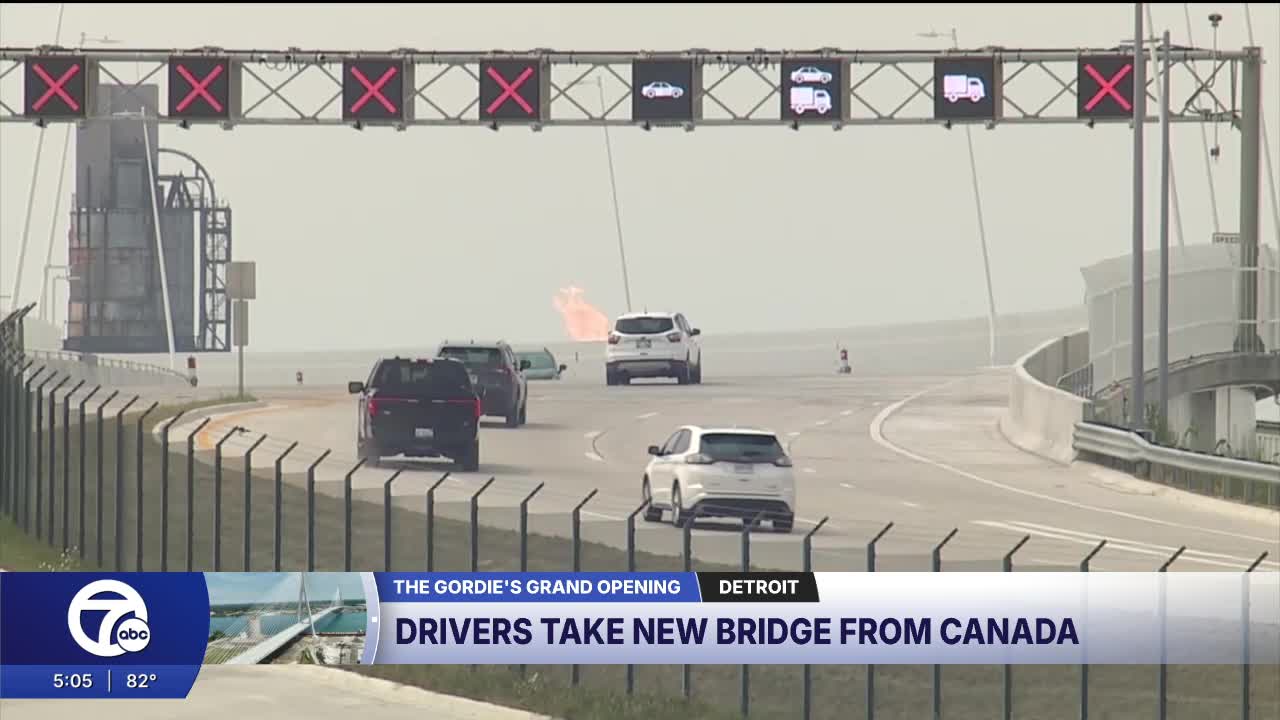


(WXYZ) — After years of construction and several delayed opening dates, cars officially began crossing the Gordie Howe International Bridge on Monday.
Watch Faraz Javed's video reports:
Motorists will be able to cross over the 1.5-mile bridge that connects I-75 in the United States and the 401 in Canada. The multi-use pedestrian and bicycle path opens to the public on Aug. 5.
Watch below: Cars begin crossing the Gordie Howe International Bridge
7 News Detroit Reporter Tony Geftos was one of the first to cross the bridge.
Watch a POV of the crossing in the video below
Watch our report from the Noon show
Howe family members were the first people to cross the bridge. Gordie Howe's grandson, also named Gordie, spoke to WXYZ after crossing the bridge about what it means.
Hear from him in the video below
Below everything you need to know about crossing the Gordie Howe International Bridge
Toll rates
Drivers of passenger vehicles will pay a standard toll fee of $8 CAD/$5.75 USD per crossing.
Commercial trucks, oversized vehicles and larger passenger vehicles will pay a standard toll of $12 CAD/$8.75 USD per axle.
Breakaway program
The Windsor-Detroit Bridge Authority also has a Breakaway Program, which is a toll discount program for the bridge. Breakaway members get up to 25% off standard toll rates through flexible account options.
You can learn more and register here.
Toll Lane Experience
The Gordie Howe Bridge website has a detailed look at the toll lane experience, saying the bridge has " advanced toll lane technology that offers different payment options and easy-to-read signage to keep traffic moving, wait times low and your journey seamless so you can cross with confidence."
There will be three icons for the toll lanes — passenger, commercial and general vehicle toll lane, open to all vehicle types.
Some lanes will be attended by a toll booth operator, while others are completely automated. Electronic payment can be made through cards or digital wallets, and cash payments can only be made at attended lanes.
Below is what the payment console will look like.

Traffic lanes on the bridge
There will be six traffic lanes on the bridge — with three going in each direction. However, depending on traffic flow, officials have the ability to convert lanes and add them.
Port of Entry features
In Canada, there are 24 primary inspection lanes. 12 will be dedicated to passenger and bus traffic, and there are 35 passenger secondary inspection bays.
In the United States, there are 36 primary inspection lanes, with 21 dedicated to passenger and bus traffic. There are 41 passenger secondary inspection bays.
The commercial and passenger lanes will be separated, and there is also a designated bus processing area.
Watch reports from Ryan Marshall and Sara Molina
Speed Limit
The speed limit on the bridge will be 35 mph/60 km/h
Connections to the Bridge
The Windsor-Detroit Bridge Authority released new information regarding connection ramps to the bridge. In Windsor, you can access it through the 401 and from Ojibway Parkway. In the United States, you can access the bridge from I-75.


Multi-use pedestrian path
The bridge includes a multi-use path that accommodates pedestrians and cyclists across the bridge. It will be toll-free and include one lane to accommodate two-way pedestrian and cyclist traffic. The path is 11.8-feet (3.6-meters) wide.
Use of the path will be toll-free, and it will have a separate port of entry processing facility along Jefferson Ave. in the United States.
The path is also expected to feature trail connections from both ports of entry in Windsor and Detroit.
U.S. Port of Entry Connections

Canadian Port of Entry Connections

Traffic management features
The bridge also includes technology that will help traffic management in both countries. According to officials, there will be border wait time information, live traffic cameras and weather information. There will be a 24/7 on-site traffic and operations management center, and the integration and coordination with Michigan and Ontario advance highway advisory systems.
