

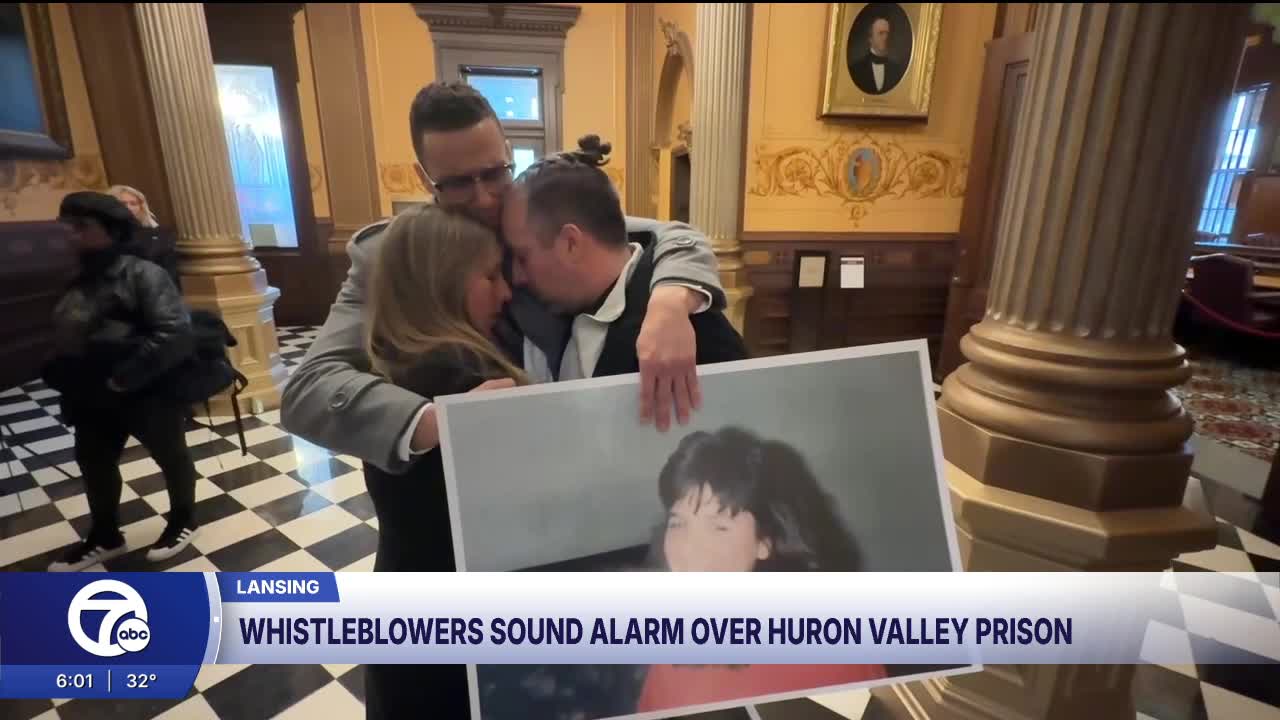


LANSING, Mich. (WXYZ) — Former employees and whistleblowers testified Tuesday before a Michigan House Oversight Committee hearing in Lansing, raising serious concerns about conditions at Women's Huron Valley Correctional Facility — the state's only women's prison — including mold, inadequate medical care, drug trafficking and retaliation against those who speak out.
Watch Randy Wimbley's video report below:
The hearing came after 7 News Detroit's earlier reporting on lawmakers visiting Huron Valley to interview inmate Krystal Clark and investigate allegations of mold. Following that story, I began receiving letters from prisoners.
One letter read: "I've been here three years and I know about two correction officers and a cook who have had sex with prisoners… Let's not forget about the officers who have been caught bringing illegal drugs in here — I know for a fact there's been a few."

LaResha Thornton, one of two former Women's Huron Valley Prison employees to testify, described a pattern of cleanup efforts timed to official visits.
Watch below: Previous coverage on lawmakers demanding answers on reported mold issue at Michigan women's prison
"The mold is only cleaned when someone from Lansing, as they say in MDOC terms, someone from Lansing comes to visit, they're going to clean up. After the visit, the mold returns instantly," Thornton said.
See the full testimony from the House Oversight Committee in the video below
Keith Barber of the Office of Legislative Corrections Ombudsman told lawmakers the scope of employee involvement may be larger than previously acknowledged.
"I do think that we need to talk about the elephant in the room, that there are employees that are involved in this, probably to a much larger scale than we would like to believe," Barber said.
Former employee Andi Allen testified that inmates face punishment for attempting to file grievances about conditions.
"Women cannot grieve or send grievances out because they are punished for them. They lose time with their family, they lose their phone calls, they get locked in solitary confinement," Allen said.
The issues at Huron Valley first drew the attention of lawmakers, including Rep. Donovan McKinney and Rep. Laurie Pohutsky. Pohutsky pointed to both the human and financial costs of the conditions at the facility.
"There is an obvious human cost here that I find very, very upsetting. But even if that's not something that is particularly salient for people, our tax dollars are also going towards one, not taking care of these people, and two, paying out lawsuits when the worst happens," Pohutsky said.
Hear more from Rep. Pothusky in the video below
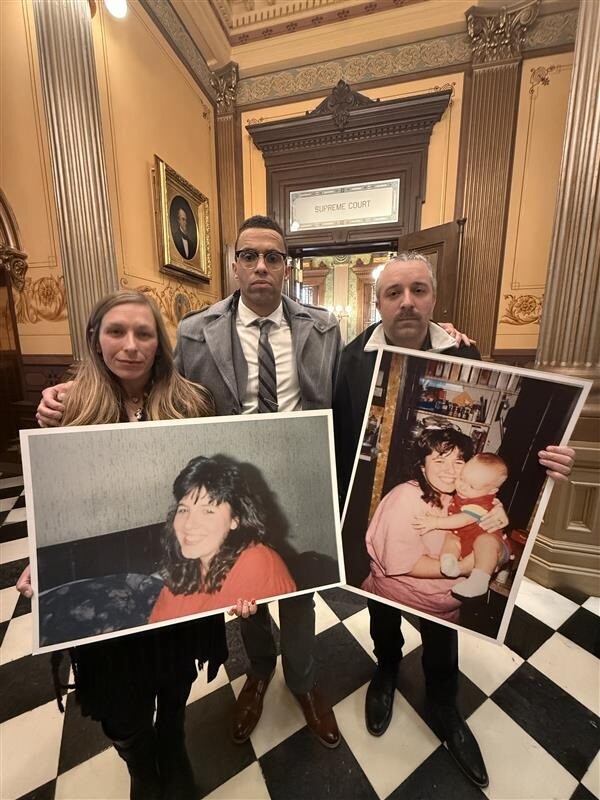
Jennifer Wallace died in prison from sepsis in November. Her family says the Michigan Department of Corrections changed her medication, which exacerbated an infection in her mechanical heart valve. Her daughter, Alexandria Levinson, testified about her mother's final months.
"They weren't taking care of her, weren't taking her needs seriously; retaliation after every grievance that she filed. And they knew how to adequately care for her health, and they chose not to," Levinson said.
MDOC provided a statement saying in part: "The department is committed to the health and safety of those currently under our supervision and provides a consistent community standard of medical care for those housed in our facilities... The department is actively working to reduce harmful contraband and dangerous incidents...The department looks forward to working with members of the legislature and our stakeholders on their concerns regarding Women’s Huron Valley Correctional Facility."
State Rep. Reggie Miller (D-District 31) catalogued a range of alleged failures at the facility.
"You have missing meals, strip searches, overdose deaths, inspectors bringing in drugs, wrong medication given to a woman who died. We're not even talking about the past rapes that the state paid out millions on," Miller said.
Miller added that the problems have gone unaddressed for too long.
"To me, this is waste, fraud and abuse that needs to be addressed, and it should have been done decades ago here at this facility," Miller said.
State Rep. Josh Schriver (R-District 66) questioned why the prison's $2.2 billion annual budget has not translated into better conditions.
"Michigan Department of Corrections budget $2.2 billion per year. The money's there, so what gives?" Schriver said.
Some lawmakers are now calling for the warden of Women's Huron Valley Correctional Facility and the director of the Department of Corrections to appear before the Oversight Committee to answer the allegations raised Tuesday. As of now, it is unclear if they will.
7 News Detroit received statements from MDOC, the governor's office and an attorney in Wallace's case. You can read those below.
MDOC Statement:
"The Michigan Department of Corrections has established itself as a national leader in evidence-based corrections, providing comprehensive programming, substance abuse treatment, education, skills training, employment readiness, and more. Over the last decade, the department has safely reduced the prison population, including the population at Women’s Huron Valley, worked to modernize facilities and operations, increased opportunities that support long-term self-sufficiency, and achieved the lowest recidivism rates in our state’s history.
"The department is committed to the health and safety of those currently under our supervision and provides a consistent community standard of medical care for those housed in our facilities. This includes preventative care, annual health and wellness screenings for all incarcerated individuals, and access to outside specialists when needed.
"The department is actively working to reduce harmful contraband and dangerous incidents. Implementation of new technologies, such as body and package scanners, are helping to deter smuggling attempts by all individuals coming into MDOC facilities. The department has invested in intelligence activities which are helping to address security risks, along with improved search procedures and officer training. MDOC is committed to holding all department staff and all facility visitors accountable should they attempt to introduce contraband into a facility.
"We appreciate our officers, healthcare employees, and all other hard-working MDOC staff that are dedicated to effectively carrying out our core missions of public safety and preparing people for success. The department looks forward to working with members of the legislature and our stakeholders on their concerns regarding Women’s Huron Valley Correctional Facility. The department is committed to being a transparent partner and will continue to provide access to all MDOC facilities to legislative members at their request and to incarcerated individuals’ health care records when those individuals have provided a release."
Statement from Stacey LaRouche, press secretary to the Executive Office of the Governor:
"The Michigan Department of Corrections has achieved historically low recidivism rates and remains a national leader in programming, education, and supervision for those in the criminal justice system. The department is committed to health and safety, including efforts to modernize facilities and prevent contraband. We continue to have full confidence in Director Washington’s leadership."
Statement from Todd Flood, founder and managing partner of Flood Law, related to Jennifer Wallace:
“Flood Law has been retained by the family of Jennifer Wallace, who died while incarcerated at the Women’s Huron Valley Correctional Facility in November 2025. Jennifer’s family deserves answers, and they will get them. Our firm is conducting a thorough, independent investigation into the timeline and circumstances surrounding her death. When that investigation is complete, we will take whatever legal action is necessary to ensure full accountability and to protect the rights of her family. Flood Law continues to represent hundreds of women, both currently and formerly incarcerated at Women’s Huron Valley Correctional Facility, in ongoing litigation involving allegations of inhumane and unlawful treatment. Jennifer’s death is not an isolated event. It is part of a pattern that underscores a fundamental truth: when institutions fail the people in their care, the human cost is real, and someone must answer for it.”
