

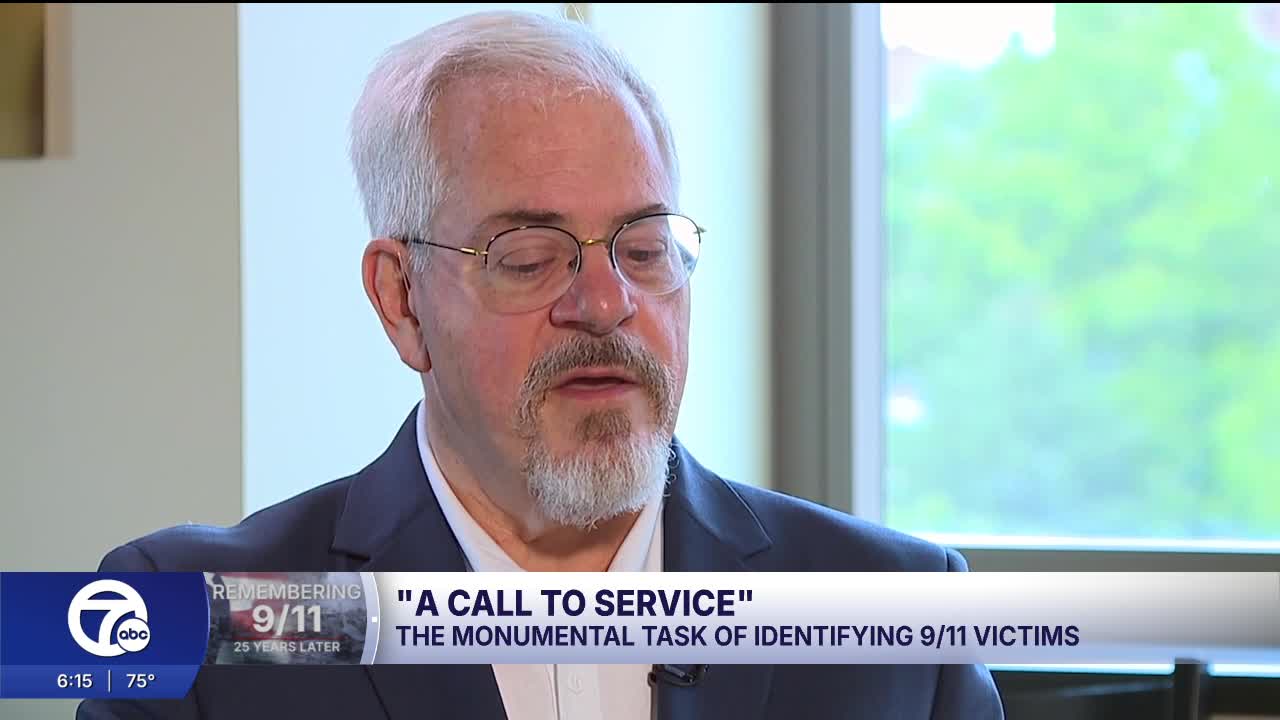


ANN ARBOR, MI (WXYZ) — A call to service. That’s how an Ann Arbor man describes the years he spent helping to identify the victims of the 9/11 attacks in New York.
In the months and years following the terrorist attacks, a small staff of software programmers and computer scientists in Ann Arbor worked around the clock to try to bring some answers to thousands of grieving families.
Watch Heather Catallo's story in the video below:
After the World Trade Center towers fell, the race to find and recover the nearly 2,800 New York 9/11 victims began.
Police and fire crews sifted through 17,000 tons of debris taken from Ground Zero and recovered nearly 20,000 fragments of human remains. Those remains then needed to be identified, leaving the New York medical examiner’s office with a horrific problem: How to do that?
“It’s as close as I will ever come in my professional life to a call to service, a call to national service, certainly,” Howard Cash told 7’s Heather Catallo back in 2002.
Watch below: Howard Cash describes the challenges they faced identifying 9/11 victims (Caution: Some of those challenges can be hard to listen to and include graphic content)
Cash is the President and CEO of Gene Codes Corporation and Gene Codes Forensics in Ann Arbor.
A few weeks after the attacks, Cash got that call to service and dedicated the next three-and-a-half years of his life to helping identify the 2,753 people who were killed in New York City.
Gene Codes Corporation made DNA identification software and was about to change the course of the 9/11 victim identification process.
“I got a call from a deputy director at the New York City Office of Chief Medical Examiner, OCMA,” said Cash. “And he said they really needed some help, could we be out there the next day?”
When Cash arrived in New York, he thought he’d be donating software. Instead, he found overwhelmed medical examiners struggling to match thousands of human remains with the flood of DNA samples provided by family members. They also had to cross reference thousands of missing person’s police reports, with the massive amounts of genetic material in order to identify victims. It was a monumental task.
“He said, ‘Someone has to organize all this stuff, and we want that to be you’. And I said, ‘I'm sorry, there's no way we can do this. We don't have anywhere near the capacity... We can't do what you want in the time frame you want it.’ And he said, ‘Well, who do you recommend? You know most of the people in this field.’ And I don't think I was exaggerating a lot when I said, ‘I know everybody in this field. And no one can do what you’re asking this fast.’ And he says, ‘Well that's what we thought. So, figure out what you don't have, hire who you need,’” said Howard Cash about his conversation with the OCME.
So, Gene Codes Forensics was born. Cash and his team worked around the clock to create new DNA matching software called M-FISys: the Mass Fatality Identification System.
“We had to write code to handle the stuff that was coming in,” said Cash, describing the months they worked until they couldn’t stay awake, then would sleep a few hours and start again. “They had been doing things with paper and highlighters, with printouts from the FBI's software of the day… We fired our software up for the first time with their data, and that first time we ran it, they found 55 new identifications that hadn't been made before.”
Making those victim identifications for the families waiting for answers kept Cash’s team in Ann Arbor moving forward, despite the long hours and high stakes.
“Once they know, they can mourn, and once they can mourn, they can move on. And for me that's very personally rewarding,” Gene Codes engineer Jonathan Hoyle told Catallo back in 2002.
Each week, Cash flew the updated software to New York. On one of those trips, he attended the funeral of fallen firefighter Dana Hannon, whose body had not been recovered yet.
“Instead of draping a flag over a casket, four people stretched out this flag in front of three firefighters who were each holding a helmet from a firehouse that this guy had worked at. And I said at the time, 'I've got to find a way to work more hours in a day,'” said Cash.
Every time he got a new set of data, Cash would check for Hannon. Eventually, the firefighter’s remains were found.
“There are people trying to find everybody, and I can tell this family — there's at least one person who's been looking specifically for them,” said Cash.
Now decades later, Cash and others still agonize over the 1,099 victims who have still not been identified.
“I've met people who never found someone who was lost at the Trade Center, and I can't help but apologize to them. I said, 'I’m so sorry, we really did everything we could,’” said Cash.
The New York Office of the Chief Medical Examiner announced in August that new genetic technology allowed them to identify one more previously unknown victim, proof that the never-ending effort to identify victims continues. The woman, whose name was withheld at the request of her family, was the 1,654th victim identified.
Back in 2002, Cash was reluctant to allow us to tell the story of the role Gene Codes was playing in the national effort. It took a lot of convincing in order for Cash to allow WXYZ to record their place in history.
“I really appreciate that you came out to kind of give us support at the time. I was worried about how the public would see it,” said Cash. “I was worried about how people would feel, that we were in some way capitalizing on something terrible. I didn't really appreciate until you left that first time, how much it meant to all my staff who were working these stunning hours that someone had come in and said, 'This really matters to the rest of us. I'm not sure I ever said thank you, but I will always appreciate that.”
Howard Cash is attending the 25th anniversary memorial service in New York. Gene Codes Forensics has gone on to help people all over the world, assisting in victim identification after mass disasters from Asia to South America, and beyond.
The work has changed him, and Cash says he feels fortunate he can play a part in bringing some peace to families who have endured these tragedies.
“Those of us who worked, especially on the recovery, something we have that is a bit of a gift is a real awareness that you never know when your number's up. That no one's promised tomorrow. And everybody knows that intellectually. But you don't think about, 'Am I wasting time here?' Until you meet thousands of people who thought they were going to have dinner with somebody, who went up the stairs, and just kept going,” said Cash.
If you have a story for Heather Catallo, please email her at hcatallo@wxyz.com
