

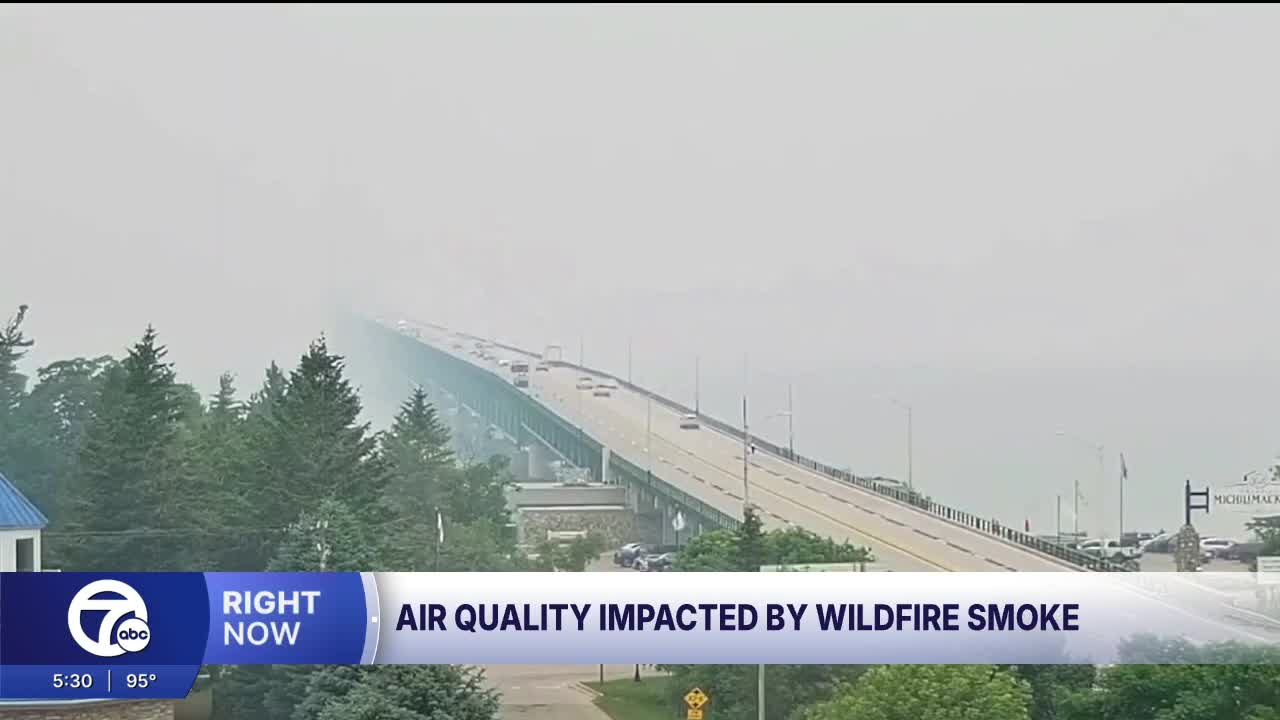


(WXYZ) — In today’s Health Alert, Michigan is under a statewide air quality alert beginning tonight due to smoke drifting in from Canadian wildfires. Officials warn that elevated levels of fine particle pollution could create unhealthy conditions for many residents over the next several days.
Wildfire smoke contains a mixture of gases and extremely tiny particles known as PM2.5. These are about 30 times smaller than the width of a human hair. And because they’re so tiny, they can travel deep into the lungs and remain there. That can lead to symptoms like coughing, wheezing, shortness of breath, dizziness, and burning in the nose, throat, and eyes.
Watch Ryan Marshall's report on the air quality Thursday morning
In more serious cases, wildfire smoke can trigger asthma attacks and worsen heart problems. It can also lead to emergency room visits and contribute to premature death.
Now, some people are more sensitive to wildfire smoke and are at higher risk. This includes adults 60 and up, children and teens, pregnant women, people with heart or lung disease, or who have underlying conditions, and outdoor workers.
That said, even healthy people should take wildfire smoke seriously. If you’re exercising outside, like running or biking, or doing physical labor, you’re likely to breathe faster and more deeply. So you’re taking in more of these harmful particles. Even spending a lot of time outdoors can increase your exposure to the smoke.
So, what can people do to protect themselves and their families when air quality is unhealthy?
The first step is to keep an eye on air quality conditions. They can shift throughout the day.
Then, if air quality reaches unhealthy levels, it’s best to stay indoors. Keep windows and doors closed and, if possible, run your air conditioner on recirculate mode. Use an air purifier or a high-quality filter rated MERV-13 or better in your HVAC system. These can help remove fine particles from smoke.
Also, try to avoid activities that create additional pollution in your home, like burning candles, smoking, vacuuming, or frying food.
And, if you must go outside, take it easy, limit your time outdoors, and consider wearing an N95 mask.
Now, for those with asthma, lung disease, or heart disease, be sure to follow your doctor’s recommendations regarding your medications and treatment plan. If you develop worsening shortness of breath, chest pain, wheezing, or severe symptoms, please seek medical attention promptly.
Unfortunately, we can’t control where the smoke comes from, but we can all take steps to protect our health.
