

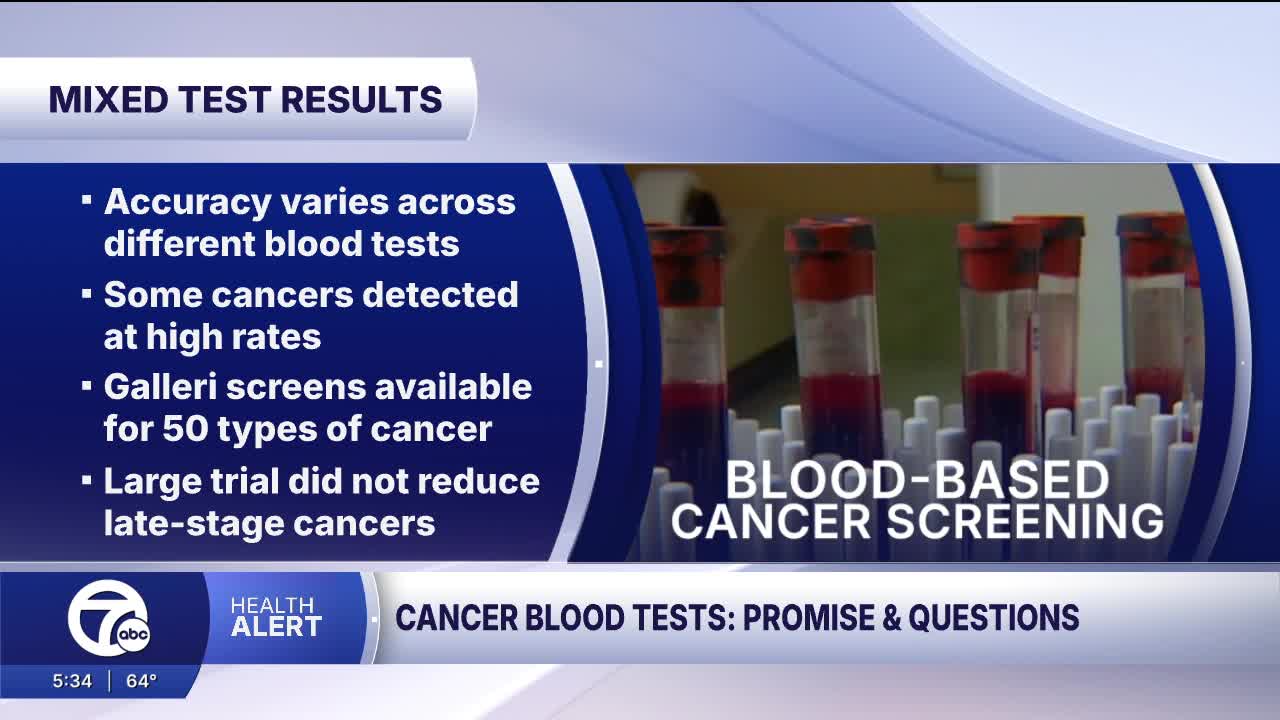


(WXYZ) — In today’s Health Alert, promising new blood tests could change how we screen for cancer, but questions remain. Are these tests accurate and ready for routine use?
There is a lot of interest in these multicancer blood tests - my patients frequently ask about them.
So, here’s how they work. They look at circulating DNA fragments in your blood. All cells in your body, including cancer cells, release tiny pieces of DNA into the bloodstream. The goal is to detect cancer signals with one blood draw, ideally before symptoms start.
Now, different tests have been studied with mixed results. One test called Mercury identified 13 cancers with about 87% accuracy overall, and about 77% at stage one. Another test, CancerSEEK, found up to 98% of ovarian cancers, but only about 33% of breast cancers.
There’s also the Galleri test, which is already available and screens for 50 types of cancer. But, during a large trial, it did not meet its own goal of reducing advanced cancers at Stage 3 and 4 among people who took the test.
However, there were still encouraging findings. Fewer advanced cancers were seen after the first round of screening in 12 serious cancers, including the esophagus, ovary, liver, lymphoma, anus, and pancreas. It also appears that more cancers in some types were found early, at Stage 1 and 2. And when added to standard screening, there was about a fourfold increase in detection for cancers like breast, colorectal, cervical, and high-risk lung cancer. Researchers also saw fewer Stage 4 cancers, which is the most advanced stage.
We don’t know yet if they improve survival. With the Galleri test, patients are being followed for up to 8 years to find out. And even then, it can be hard to measure because cancer treatments are improving at the same time.
There are also limitations. Accuracy can vary because some tumors don’t shed much DNA into the blood, especially early-stage breast or prostate cancers. You may also test negative for a cancer that you actually have. Or, you could have a false positive, which can lead to anxiety and extra testing.
Right now, these tests are not FDA-approved for routine screening. They are often not covered by insurance and can be expensive. So I don’t recommend replacing standard cancer screenings.
If someone is considering it, there should be a conversation with their doctor. It may help find cancers we currently miss, especially ones like pancreatic or ovarian cancer that don’t have routine screening. Just be aware of the risks.
This Week on the Dr. Nandi Show

Driven to help others, Dr. Nandi, MD explores exceptional healing methods that have eluded scientific study. Techniques where the “how” and “why” can’t be scientifically explained, but the results can’t be ignored. Guest Jennifer Hough discusses the power of your thoughts and their impact on your health. Gary Stuart reveals how ancestral DNA can affect your life and what to do about it. Dr. Lin Morel tells how to approach life when bad stuff happens. Angelica Singh explains the Embodiment Process. And two extraordinary young girls can “read” while blindfolded, by tapping into their other senses. Tune in this Monday, April 27th at 2:30 AM.
