



(WXYZ) — In today’s Health Alert, as more cases of cyclosporiasis in Michigan are being reported and no source has been identified, many viewers are concerned about how they could become infected.
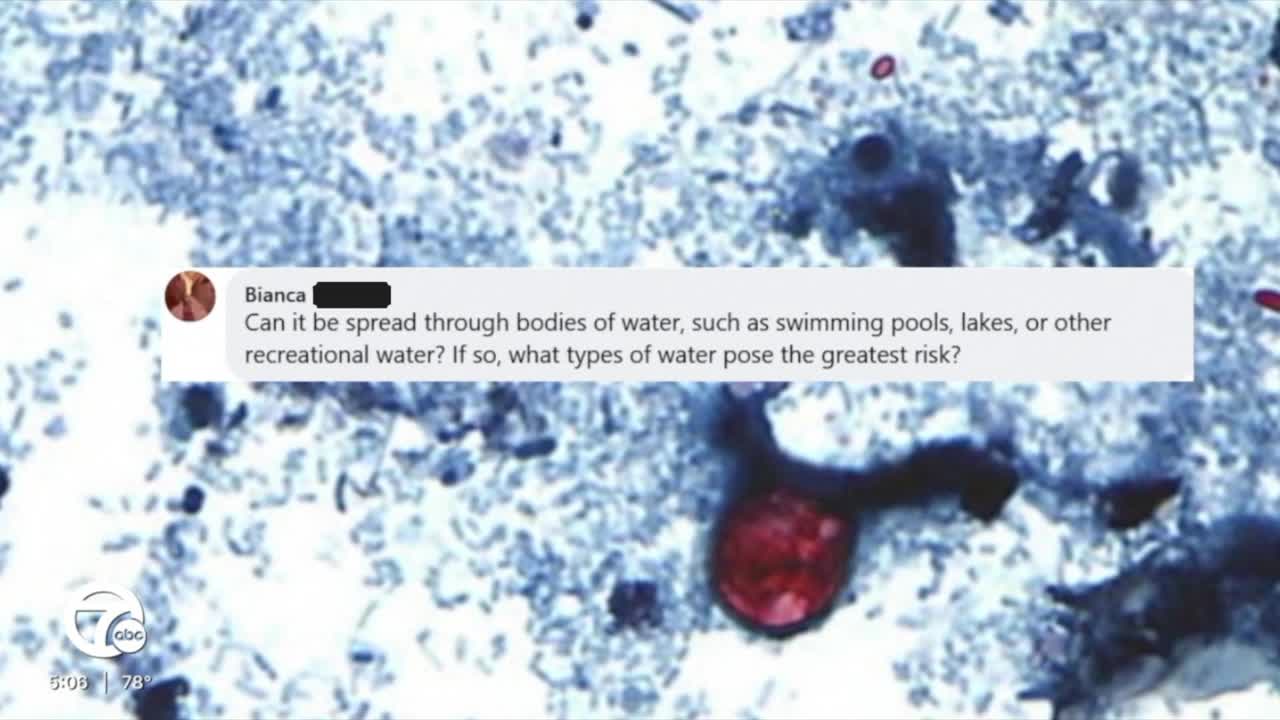
So, we asked viewers to post questions to our Facebook page, and one important question came up: Can this parasite be spread through recreational water, and what types of water pose the greatest risk?
That’s a great question because many people are finding relief from the heat by heading to public pools and beaches.
Now, we know that Cyclospora is most commonly spread through contaminated food, especially fresh produce. However, contaminated water is also considered a possible source of infection. The parasite is shed in human stool, but it doesn't become infectious right away. It actually needs about one to two weeks in the environment to mature before it can infect someone else.
So, when it comes to recreational water, it’s possible that Cyclospora may be able to survive for quite some time. And get this, it's resistant to chlorine. So swallowing contaminated water from lakes, untreated water sources, or potentially even pools or splash pads could pose a risk if conditions allow the parasite to mature and remain infectious.
At this point, there have not been any documented outbreaks of cyclosporiasis linked to properly maintained swimming pools. Most outbreaks that investigators have traced back over the years have involved contaminated produce or water used to grow or wash food. And right now, contaminated food still appears to be the biggest concern.
That said, if you plan to hit the beach or visit places with recreational water, try not to swallow the water. Also, shower before and after swimming, and always wash your hands well after using the bathroom or before eating or drinking. And if you have diarrhea, please wait at least two weeks after it’s gone before swimming.
Another question comes from Sharon Pelkey-Robinson.
She writes: “I am on my 15th day. I didn’t start feeling better until, on my 12th day, I went to the doctor and he put me on antibiotics. Do they know how long it takes to feel 💯? Is there a certain vitamin that may help?"
Sharon, first of all, I'm sorry you're going through this. The good news is that many people start feeling better within 7 to 14 days after starting treatment. But, frustratingly, some people can continue to have occasional diarrhea for up to a month.
Now, as for vitamins, there isn't a specific one proven to treat Cyclospora. The most important things are staying hydrated, replacing lost electrolytes, and eating nutritious foods as you're able. Severe diarrhea can leave you depleted, so water, broth, and electrolyte drinks can really help during recovery. In severe cases, IV fluids may be needed.
Another viewer, Cathy Harris, asks: “I am allergic to Sulfa. I’ve heard that’s not good in this case. What will doctors do for me if I get it?”
That's another excellent question. The standard treatment for Cyclospora is an antibiotic called trimethoprim-sulfamethoxazole, or TMP-SMX. It’s sold as Bactrim, Septra, or Cotrim, and it contains a sulfa medication.
Now, if someone like Cathy has a sulfa allergy, doctors may prescribe other options like ciprofloxacin or nitazoxanide. Fortunately, most people with healthy immune systems do eventually get better, even if they don't receive treatment – it just may take longer.
But because this infection can sometimes be prolonged or more severe, especially in people with weakened immune systems, it's important to speak with your doctor right away if symptoms develop.
We have two more questions from viewers about preventing infection.
Karen Casey asks: “Is there something we can wash our fresh produce with that will remove Cyclospora?”
That's a great question because many people are wondering the same thing. Right now, there is no special wash or product that has been proven to completely remove Cyclospora from fresh produce.
In one study in 2021, researchers in Norway tested different ways to wash berries contaminated with Cyclospora. They found that a vinegar solution - one part vinegar with three parts of water – removed more of the parasite. But unfortunately, it still did not remove all of it.
So, the best thing you can do is rinse fruits and vegetables thoroughly under running water. If your produce has leaves, remove the outer layers and separate the leaves as you wash. Scrub firm produce well, and be sure to cut off any damaged spots. And always wash your hands, cutting boards, and kitchen surfaces before and after preparing fresh produce.
And Tami Taylor Hanaka asks: “Is it safer to use frozen raspberries instead of fresh?”
I can see why frozen raspberries may seem like a better option during this outbreak. Fresh raspberries can be very difficult to wash thoroughly due to their bumpy texture. And, many U.S. outbreaks have been linked to contaminated fresh produce, including raspberries.
That said, freezing does not guarantee that cyclospora is eliminated. However, the good news is that commercially frozen produce has not been identified as the source of those outbreaks.
If you are concerned about a specific fruit or veggie, frozen may be a reasonable alternative. And when possible, cooking produce to 158°F or higher is another way to help reduce the risk because heat can help kill the parasite.
This Week on the Dr. Nandi Show:

Dr. Nandi, MD, explores how the foster care crisis has led to a shortage of foster homes. Leading Foster Care Expert Dr. DeGarmo has cared for over 50 foster children and reveals why so many kids need homes. A guest shares how her child-molesting step-father led to a string of foster homes, with one foster parent exploiting her as a round-the-clock live-in babysitter. Dr. Nandi explores fostering challenges with National Parenting Expert Dr. Sue Cornbluth. And a former foster child shares how the right loving home can positively impact the outcome of your life. Tune in this Sunday, July 12th, at 2 a.m. (early Monday morning).
