



(WXYZ) — The smoke from the wildfires in Canada and Minnesota is a serious health risk, with many people wondering what's actually in the smoke we're breathing.
That’s a great question because many people think wildfire smoke is simply burnt wood in the air. But it’s actually much more complicated than that.
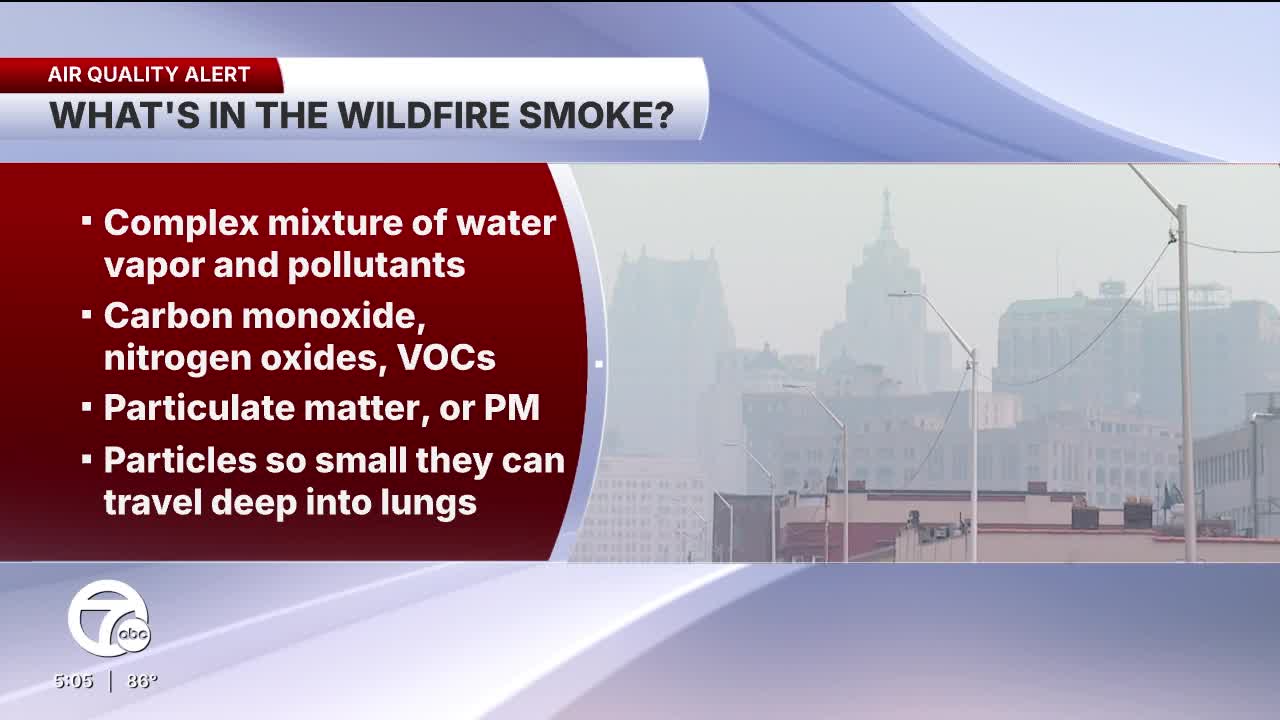
Of course, wildfire smoke does contain particles released by trees, plants, and other natural materials as they burn. But it’s also a complex mixture of water vapor and pollutants, including gases such as carbon monoxide, nitrogen oxides, and volatile organic compounds, as well as other potentially harmful chemicals.
One of the biggest concerns is particulate matter, or PM. With wildfire smoke, we’re especially concerned about fine particulate matter, or PM2.5 for short. And what makes these particles so concerning is that they’re so incredibly small that they can travel deep into the lungs.
Now, as for our viewer questions, people have been wondering what's safe and what's not. We turned to the WXYZ Facebook page to get some of those questions answered.
Sherry says she's currently camping at Burt Lake State Park. She wants to know what advice I have for campers.
I feel for you, Sherry, because it’s bad timing that you’re camping right now. And when people camp, especially if you’re tent camping, you may not have access to air conditioning or a place with filtered air.
Unfortunately, the area around Burt Lake State Park is currently experiencing an Air Quality Index level in the maroon (hazardous) category. That is the highest category on the AQI scale. At this level, everyone - not just people with health conditions - is more likely to experience health effects from the smoke.
If you can, move indoors to a place with cleaner air, keep windows and doors closed, and use air conditioning on the recirculate setting if available.
I would also avoid activities that increase your breathing rate, like hiking, biking, or other strenuous exercise. If you absolutely have to be outside, consider wearing a well-fitting N95 mask, which can help filter out the fine particles in wildfire smoke.
Another viewer, Lauren Jenkins, asks: "How badly will this affect my 1-year-old and my 8-year-old? We still had to leave the house for school and work."
Lauren, I understand why parents are worried. Children are among the groups most sensitive to wildfire smoke because their lungs are still developing. They also tend to spend more time outdoors and are often more physically active. They can breathe in more air per pound of body weight than adults, which means they may take in more smoke particles. And that means they may be more vulnerable to the effects of wildfire smoke.
Now, a brief trip to school or daycare does not mean your children will become ill. But it’s important to watch for symptoms such as coughing, wheezing, unusual fatigue, shortness of breath, or complaints of chest discomfort.
And for children with asthma, wildfire smoke can make their symptoms worse and may even trigger an asthma attack. If it’s possible when traveling, keep car windows closed and use air conditioning on recirculate. The same goes once you’re home.
And since the air quality is unhealthy today, I’d also try to keep the kids inside and use an air purifier if you have one. And if anyone develops difficulty breathing or symptoms that seem to be worsening, seek medical attention promptly.
Our final question is from Laurel Clemons, who says her 14-year-old daughter, who has sports-induced asthma, practices Brazilian jiu-jitsu at a gym with the doors open. She wants to know if it is safe for her to practice.
I think it's a great question. I think it has multiple parts to it, you know, so she is young. Number 1, the air quality index is not great, and 3rd, she's got asthma.
So I'll break it down.
Number 1 is that the air quality index is in that maroon phase, right, which is like the most hazardous. So it's not great for anybody, first of all, even if you don't have health conditions. But let's talk about her. She's young; as a teenager, she's actually breathing in more than I do when she's active, so per inch of lung area that she has, she's putting in more. Guess what? More of those particles, those bad particles, are coming in. So it's even more for her if she tries to do this. So, the third thing is the asthma, and that's the most important: she has exercise-induced asthma.
So what happens is that when you have conditions like this. It can trigger asthmatic attacks, so she's at risk. So if I were her dad, I would say Please don't practice today, you know, please just hold off.
But if she absolutely has to, check with the health care provider, and make sure you have your asthma medications nearby. What should she watch out for? If she experiences any chest pain, wheezing, or shortness of breath, she needs to get help immediately because it can be a crisis for her.
