

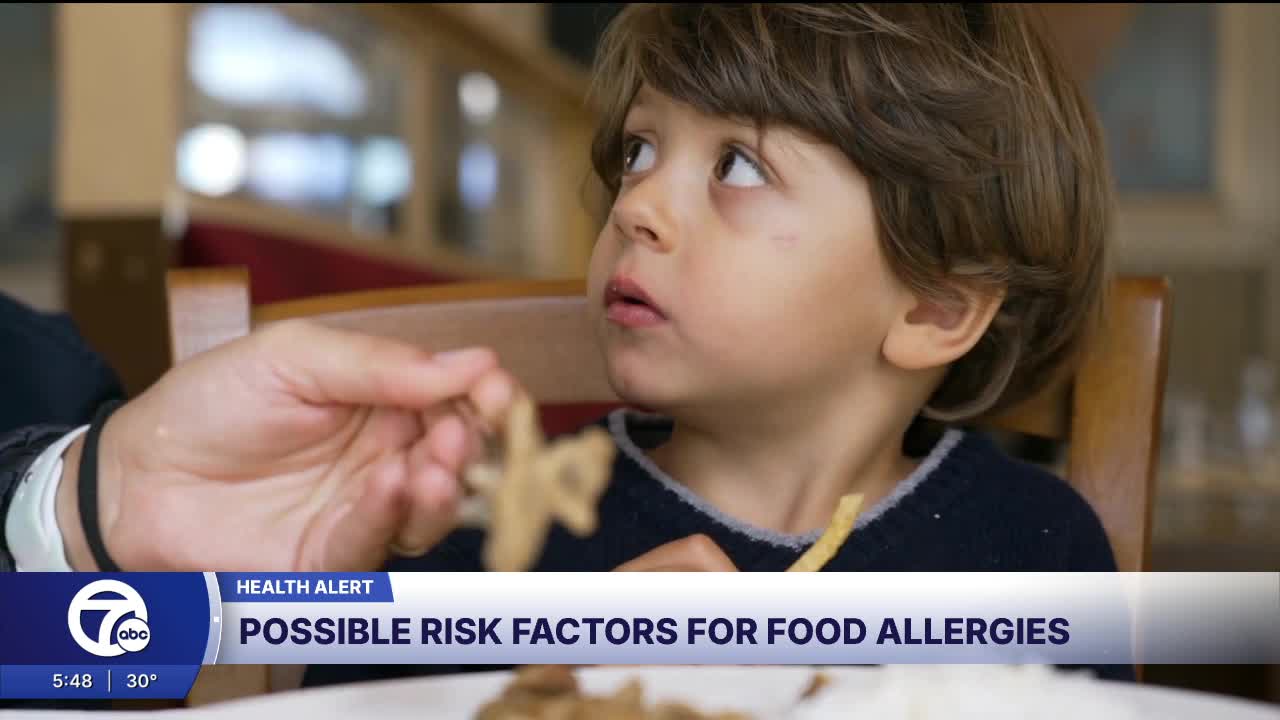


(WXYZ) — In today’s Health Alert, data from nearly 3 million children shows that by age 6, as many as 1 in 20 may develop a food allergy. Researchers identified major and minor risk factors that could help explain why.
This is one of the largest reviews we’ve seen on childhood food allergies. It looked at 190 studies across 40 countries and analyzed more than 340 potential factors.
And here’s what researchers found: the strongest risk factors start early in life. Babies who develop eczema in their first year have three to four times the risk. Antibiotic use in the first month of life was another major factor, increasing the chance up to fourfold. Children with nasal allergies have three times the risk, and wheezing or asthma symptoms double the odds. Delaying the introduction of common allergens like peanuts, eggs, or nuts beyond the first year raises the risk by about 2.5 times. And having allergic parents or siblings also doubles the likelihood.
Now, the review also identified smaller but still meaningful factors. These include being male, being the firstborn, birth by cesarean section, identifying as Black, and having parents who migrated before the baby was born.
Here’s what they didn’t find that increased the risk of food allergies: low birth weight, birth after 42 weeks, partial breastfeeding, household income, and even a mother’s diet or her stress during pregnancy.
It’s great that they’ve narrowed down key risk factors, but why about 5% of U.S. kids develop food allergies by age 6 is still complicated. Researchers describe it as a “perfect storm,” with genetics, skin health, gut bacteria, and the environment potentially interacting together. However, they don’t fully understand how these factors work together.
So what can parents do? Well, the strongest prevention strategy is the early introduction of allergenic foods. Around 4 to 6 months, when babies are developmentally ready for solids, introducing infant-safe forms of eggs, dairy, peanut-containing foods, and other common allergens may actually lower the risk. In fact, early peanut introduction can cut the risk of peanut allergy by up to 80%.
Now, if a baby has eczema, a family history of allergies, or any of the risk factors identified in this study, it’s important to work closely with your child’s pediatrician first. What’s encouraging is that this review could help identify babies at risk of food allergies and potentially prevent some food allergies before they ever begin.
This Week on the Dr. Nandi Show

Discover the hidden struggles of fibromyalgia, a condition affecting 2-4% of Americans. Dr. Partha Nandi, MD, uncovers how the brain of someone with fibromyalgia differs from those without the condition. Guest Ann Vencil shares her powerful personal journey, while Rheumatologist Dr. Thomas Sulich offers expert insights into this condition that causes musculoskeletal pain and fatigue. Tune in this Saturday, February 14th, at 12:00 PM.
