

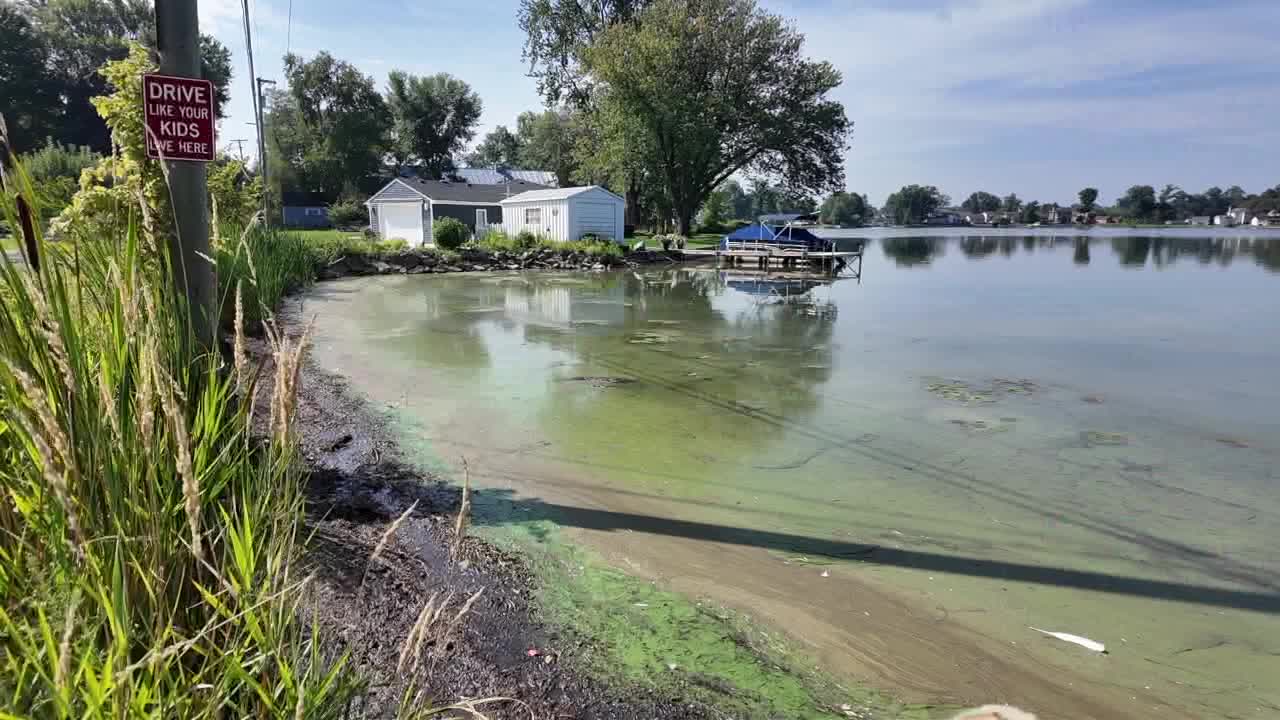


Toxic algal blooms that appear in Michigan lakes this time of year may pose health risks beyond touching or swallowing the algae — researchers now say breathing it in could also be dangerous.
WATCH VIDEO REPORT FROM TONY GEFTOS BELOW
The bright green pond scum visible at Pontiac Lake is part of the cyanobacteria family of algae. Researchers have long warned against touching, swimming in, or ingesting it, but new evidence suggests airborne exposure may also be a concern.
Dr. Gregory Dick, director of the Great Lakes Center for Freshwaters and director of Human Health at the Cooperative Institute for Great Lakes Research at the University of Michigan, is among those studying the potential risks.

"Yeah, there's new, kind of emerging lines of evidence that have us more concerned or at least concerned in new ways about these toxic algae," Dick said.

Dick leads teams of researchers from the University of Michigan and the University of Toledo, collecting samples of toxic algae on Lake Erie. They are now also collecting air samples to better understand how toxins travel from the water into the surrounding environment.
"We need to get a handle on how much toxin is in the air, you know, what levels of toxin are a concern for people so that we can, again, take appropriate precautions," Dick said.

The concern is that cyanobacteria can become airborne and enter people's lungs.
"You know, we have some emerging evidence, I would say, that has us concerned about what those health risks are," Dick said.
The same type of harmful algae found in Lake Erie can also appear at Pontiac Lake, Dick confirmed.
Regular Pontiac Lake fisherman David Cantley said he tries to stay out of the water.
"I mean, it doesn't bother me. Like I said, I don't go in the water," Cantley said.

Some people at Pontiac Lake said the airborne risk makes sense to them.
Jeff McKenna, who avoids swimming in Pontiac Lake, said he was not surprised by the findings.
"I have a biology degree from U of M and I understand how that works. Our lungs are very moist, so it makes a lot of sense," McKenna said.

Others said they were not worried. Ben James, visiting from Arizona, said he felt protected regardless of the risk.
"I feel like God is protecting me, so anything that happens, I'm going to be protected," James said.

Dick said the most important precaution people can take right now is to stay out of the visible algae.
"Yeah, the real key is you want to keep yourself and your kids and your pets out of that green scum that's on the surface of the water. It can be quite dangerous," Dick said.
Dick plans to continue researching the potential effects of airborne algal toxins over the next 2 to 3 years. His team is also studying volunteers who have been exposed to toxic algae and tracking their symptoms.
"We have a lot to learn. We don't fully understand, you know, what the risks are and so that's why we're doing this research to try and understand, you know, how far from the lake is this toxin being transported? What are the concentrations of those toxins in the air? And just what are the risks to people?" Dick said.
This story was reported on-air by a journalist and has been converted to this platform with the assistance of AI. Our editorial team verifies all reporting on all platforms for fairness and accuracy.
