

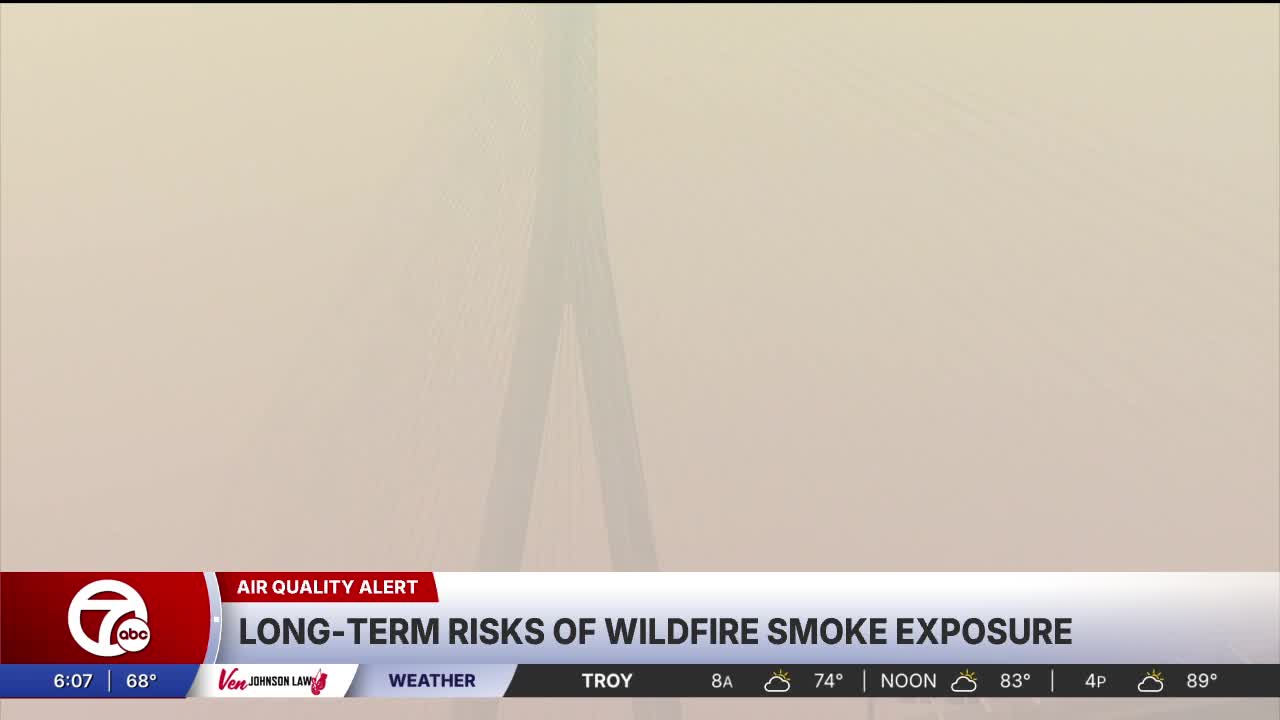

Smoke from wildfires in Canada and northern Minnesota is hanging around on Friday, and it's not the first time the state has seen drifting smoke.
It's a repeat of scenarios that happened in both 2023 and in 2025. The fine particulate matter in the smoke can get deep in your lungs and even enter your bloodstream.

Longterm exposure to these particles greatly increases someone's risk for diseases like COPD and lung cancer.
Dr. Devang Doshi, an allergist and pediatric pulmonologist at Corewell Health, joined 7 News Detroit This Morning to talk with Keenan Smith about the risks.
Watch his full interview in the video below
Question: What are the most concerning long term health risks associated with repeated exposure to wildfire smoke?
Dr. Doshi: A lot of these patients that are continually exposed to this, even episodically, like we've been seeing for summers, are going to be at increased risk for lung disease, COPD, asthma, even risks of lung cancer. And like you mentioned, these particulate matters do enter the blood stream and put patients at high risk for heart disease, high blood pressure, heart attacks, and even neurological impacts of increased risks for strokes and dementia. So they have to really be careful.
Question: Those are things that we think about for people down the line. Is this a concern for children?
Dr. Doshi: Yes, I mean this is certainly going to accelerate it. More continuous exposure we have, this has an accumulative lifetime effect. So it's going to take an impact on our health overall. There are even reports that show it affects babies during pregnancy, before they're even born. It can lead to low birth weight, and affect the baby even before they're born if pregnant mothers are exposed.
Question: How can people differentiate if symptoms are from wildfire smoke or something far less serious like seasonal allergies?
Dr. Doshi: With the levels we've had, the smoke is so intense that you can smell it and almost taste it in your mouth. Not only that, you can see this haze. If you go outside and you start feeling symptoms rather quickly - burning eyes, nasal symptoms, throat burning, chest tightness, cough, etc.,, it's probably related to wildfire smoke. If you do suffer from seasonal allergies regularly and you're usually taking medications to alleviate those symptoms and they're not working, and you're outdoors without wearing protective gear like an N-95 mask, it's probably related to wildfire smoke.
