

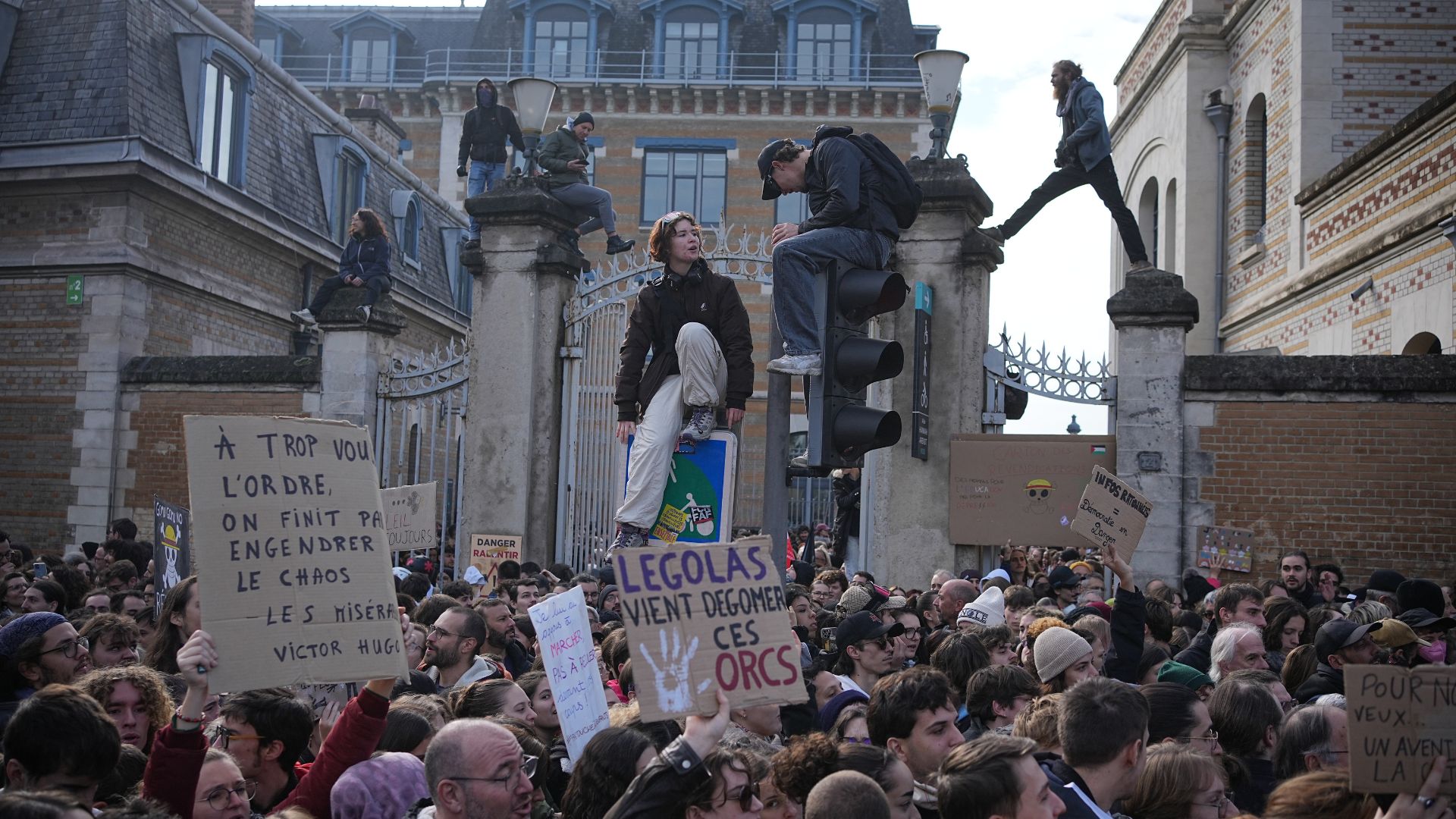


France’s Interior Ministry said more than 600,000 people rallied Thursday across France, including in Paris, to demand higher wages and support the student protest movement, piling fresh pressure on the beleaguered government.
After more than a month of large, recurring protests across France, major rallies took place again in Paris, Lyon, Marseille and elsewhere, most of which were peaceful. The Interior Ministry said the figures were still provisional.
RELATED STORY | French protesters defy heavy police presence in new demonstrations
The Paris march proceeded peacefully Thursday afternoon, drawing a massive crowd, including students carrying signs reading, “Inequalities seriously jeopardize our future” and “We can’t spend our whole lives just trying to make a living.” Workers and retirees also joined, demanding higher wages and pensions.
About a third of France’s high schools were closed or unable to operate, some because of student blockades and others because teachers were on strike. Public transportation was disrupted in some areas. The Eiffel Tower was also closed.
Police are prepared but tensions flare again
Interior Minister Laurent Nuñez said that 70,000 police officers were deployed, backed by armored vehicles, drones and helicopters. Police have been criticized for injuring protesters with heavy-handed tactics.
Many demonstrations in recent weeks have been marred by violence, which authorities blamed on masked far-left radicals seeking to incite insurrection and others intent on looting.
Authorities in the western region of Brittany said masked individuals tried to block roads in Rennes. They said young people, often accompanied by adults, committed “serious acts of violence,” including throwing steel balls at police.
Authorities also reported tensions, scuffles and other incidents in the cities of Lyon, Nantes, Pau, Orléans, Rennes and Toulouse.
Unions aim to send a warning
France’s main unions warned that the country is on the brink of recession and that layoff plans are multiplying. “Fuel, food products, rent, gas, electricity … everything’s going up except wages and pensions,” they said in a joint statement.
France is mired in debt and is one of the worst economic performers in Europe, along with Italy and Belgium.
“We need to give every single children here in this country a proper future,” said Garance Blaise, a 21-year-old university student taking part in the Paris march.
“It's all about the way we don’t know whether we’ll get a job or not. And our parents, they know that and they agree with us and they also have things to ask for,” she said. “So I think the movement is already global, it is already all over Europe and it’s not just students, it’s the whole population.”
Corinne Cucchini, from the Private Healthcare Federal Union, joined the Paris demonstration to denounce “staff shortages and a lack of equipment” at the private hospital in Paris where she works. “Our demands focus on raising wages and the working conditions,” she said.
IN CASE YOU MISSED IT | France wakes up to wreckage of a night of rioting after protests turned violent
Fabien Villedieu, national secretary of the SUD-Rail union, took aim at President Emmanuel Macron 's centrist government and the national rail company, SNCF.
“When the government is not reasonable, when the head of the SNCF is not reasonable … we simply do what we’ve always done in France, which is to go on strike,” he said at the Gare de Lyon station in Paris.
Before the strike action, the government had been negotiating with unions — a familiar scenario in French politics — in hopes of limiting the protest movement, which has resulted in France's most violent civil unrest in years.
Protests are drawn into election campaigning
The movement began in September with a protest over staff shortages at a high school southeast of Paris and spread nationwide. It drew students demanding more education funding and then broadened to workers seeking better pensions and help with soaring fuel prices and other costs.
Thursday's demonstrations come as the campaign to succeed Macron as president next May heats up, with political leaders seeking to capitalize on the movement. Macron is constitutionally barred from seeking a third consecutive term. Far-right contender Marine Le Pen is the favorite to win.
Some candidates participated in the Paris march, including veteran far-left firebrand Jean-Luc Mélenchon, Green leader Marine Tondelier and Raphaël Glucksmann, who represents the moderate left.
“There is a sense of absolute frustration at the government’s failure to operate,” said Paul Smith, an associate professor of French history and politics at the University of Nottingham in England. “Whoever wins the presidential election is going to have a stack of problems to cope with.”
“It’s very difficult to see exactly where things go,” he said.
