

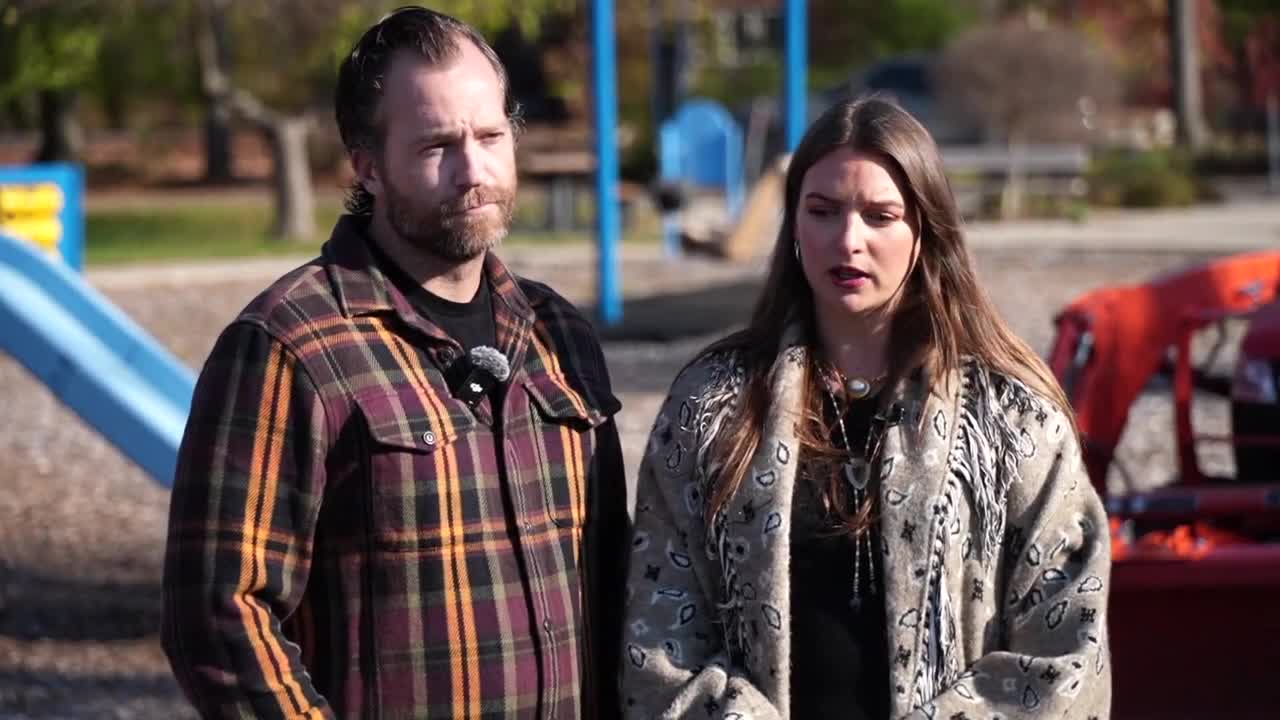

Michael & Emilia Robinson
Lathrup Village Park Volunteers. 2024 – Present. Lathrup Village, MI. Present Day. When the city ran out of money, this family picked up a paintbrush.. The Robinsons live down the street from Sarrackwood Park in Lathrup Village — a suburb just north of Detroit — and stepped in to restore the playground after city budgets left it overgrown, rusted, and unsafe for children.
Sarrackwood Park was not closing. No one posted a sign. Kids kept showing up every single day — climbing on rusted equipment, landing on exposed concrete where wood chips had long since worn away. For most of the neighborhood, that was just the way things were.
For Emilia Robinson, it was a problem she could not walk past anymore. She lives just down the street from the park in Lathrup Village, and after attending city Parks and Recreation Committee meetings and digging through budget documents herself, she found the answer she did not want: there really was no extra money.
- 5 — Parks in Lathrup Village — All managed on a shared budget
- $20,000 — Annual parks budget — For all five parks combined
- $6,000 — Wood chips alone — Annual cost at just one park
- 0 — Paid staff on committee — Parks and Rec is all-volunteer
The math is blunt: Lathrup Village has five parks and $20,000 a year to maintain all of them. Replacing the playground-certified wood chips at a single park — the kind that meet safety standards and cushion a child's fall — costs $6,000 on its own. That is nearly a third of the entire annual budget, for one supply item, at one park.
Sarrackwood Park has an additional layer of challenge. It sits off dirt roads, is not ADA compliant, and does not qualify for most grants, according to Christina Schindler, chairwoman of the Lathrup Village Parks and Recreation Committee — a body made up entirely of volunteers.
I kept going to parks and rec meetings and just kept asking questions, and then I kept looking into the budget as to why there was no money when we do pay such high taxes around hereEmilia Robinson, Lathrup Village resident
Mark Melesky did not need to know any of those numbers to understand what was at stake. He was at Sarrackwood Park with his 2-year-old grandson Kai when a reporter stopped by — and his take on the place was simple: families with young children need spaces exactly like this one.
The Robinsons have an 18-month-old daughter of their own. For them, the park down the street was never an abstract civic issue — it was the place their child would grow up playing. That personal stake turned into painted equipment, cleared weeds, a new sandbox, and a volunteer network that is still going.
Even though it looked so bad, there were still kids here every day playing on it, and some of it's a little hazardous, and that's what we've tried to fix to make it more safe for everybodyEmilia Robinson, Lathrup Village resident
How to Step Up for Your Own Neighborhood Park
- Document what you see — Take photos of specific hazards — exposed concrete, broken equipment, standing water. Visuals are your most powerful tool at city meetings.
- Attend Parks and Recreation meetings — Show up consistently and ask specific questions about the budget. Emilia Robinson learned the full financial picture only by attending multiple meetings over time.
- Find out what your park qualifies for — Some parks can apply for grants; others, like Sarrackwood, cannot. Knowing the constraints helps you plan around them instead of waiting for solutions that may not come.
- Start with what you can do yourself — Painting, weeding, and building a sandbox require time and energy, not a city contract. Small visible improvements build momentum and attract other volunteers.
- Build a volunteer team — One family can restore a park. A network of neighbors can maintain it. Organizing others spreads the work and creates community investment in keeping the space alive.
- Open a fundraiser for recurring costs — Playground-certified wood chips and other safety materials cost real money every year. A community fundraiser can help cover expenses the city budget cannot reach.
What the Robinsons built at Sarrackwood is not just a cleaner park — it is a proof of concept for how Lathrup Village residents can close the gap between what the city can fund and what a neighborhood actually needs. The Parks and Recreation Committee is all volunteers. The budget covers the basics, barely. Everything beyond that depends on people deciding not to walk past the problem.
Sarrackwood Park still has real challenges ahead. The equipment is aging, the site is off dirt roads, and the ADA access issue has no easy fix. But children are playing there safely today because one family refused to let it become just a green space.
About the Lathrup Village Parks System
Lathrup Village maintains five public parks on a combined annual budget of $20,000. The Parks and Recreation Committee, which oversees the parks, is staffed entirely by volunteers — there are no paid positions on the committee.
Sarrackwood Park faces unique constraints: it is surrounded by dirt roads, is not ADA compliant, and does not qualify for most grant programs, according to committee chairwoman Christina Schindler. Those factors make outside funding difficult to obtain and place more pressure on the city's limited general budget.
Playground-certified wood chips — the specific material required for safety compliance beneath play structures — cost approximately $6,000 per year at a single park. With $20,000 budgeted across five parks, that single line item represents 30 percent of the entire annual allocation.
Support the Sarrackwood Park Restoration
- Donate to the Robinsons' GoFundMe: The family launched an online fundraiser to help cover ongoing park expenses, including playground-certified wood chips and other maintenance costs.
- Volunteer in your own neighborhood: If you live in Lathrup Village or a surrounding community, attending your local Parks and Recreation meetings is the first step toward making a difference.
Michael and Emilia Robinson's story is a Detroit-area story — the gap between what a community deserves and what a strained municipal budget can deliver is not unique to Lathrup Village. It plays out in neighborhoods across Metro Detroit every summer, in parks where the wood chips are thin and the equipment is a few rust spots away from being fenced off.
What is unusual is what the Robinsons chose to do about it. They showed up. They organized. They painted over the rust, dug out the weeds, and kept coming back. Sarrackwood Park is better today because of them — and that is a model any neighborhood can follow.
