

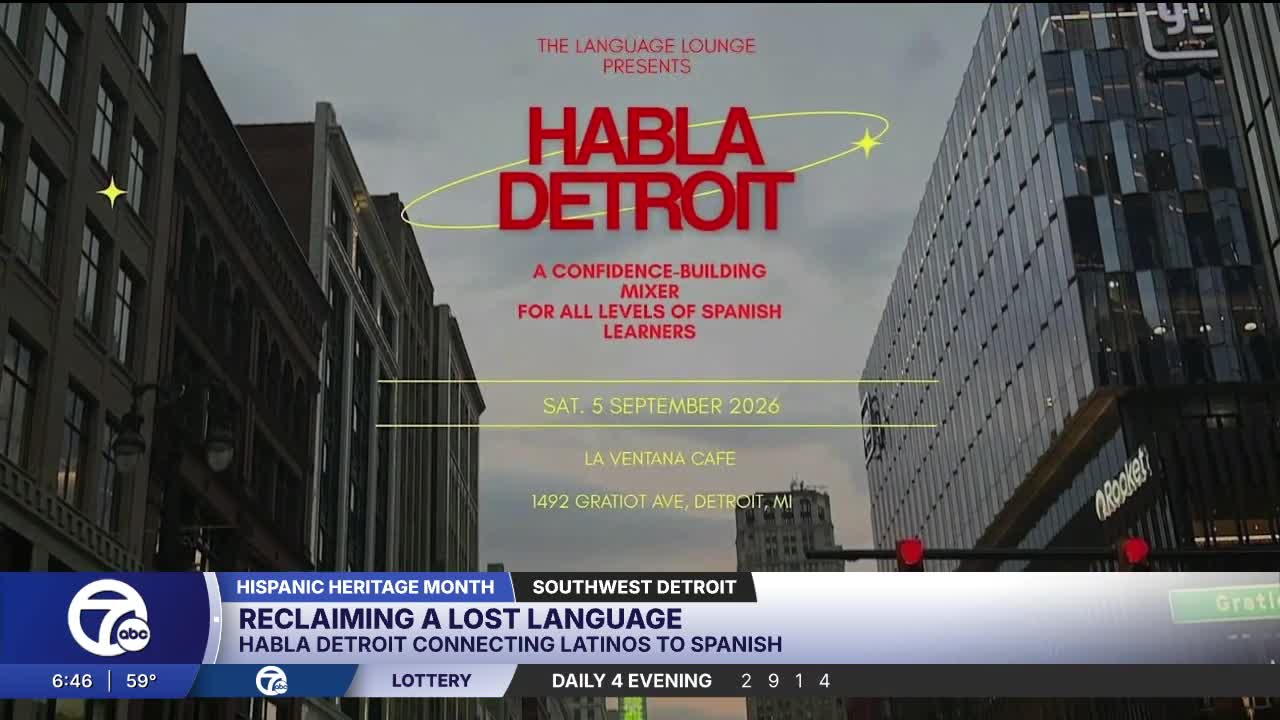


DETROIT — As Hispanic Heritage Month continues, many Latinos are reflecting on the role language plays in their identity and culture.
For some, Spanish is the language they grew up speaking at home. For others, it is a connection that's faded over generations as families adapted to life in the United States. Now, a growing community in metro Detroit is helping people reclaim that connection.
See the full story from Sara Molina in the video below
It's called Habla Detroit, founder Bethany Cox said the group was created to help people build confidence while learning or rediscovering the language.
"It is a space for people to be able to build their confidence and practice their Spanish in a space where they can feel safe and not feel afraid to make mistakes," Cox said.
Cox said she's been learning Spanish for more than a decade. After studying linguistics in college, she began creating language-learning content on social media. In just two years, she has built an audience of more than 160,000 followers across TikTok and Instagram.
Last month, she brought that online community into the real world by hosting Habla Detroit's first Spanish-speaking mixer.
"I open Habla Detroit to anybody on any level, whether you only know how to say 'hola' or whether you grew up with native-speaking parents in the household who didn't speak the language for any reason," Cox said.
For many second- and third-generation Latinos, that experience is deeply personal.
"I hear from a lot of second and third generations that they're ashamed, that they're embarrassed that they don't know the language, that they can't communicate with their family members," Cox said.
Research from the Pew Research Center shows Spanish use and proficiency often declines from one generation to the next. Experts say the trend is closely linked to assimilation.
"Because the American story has always been about assimilation," said Jorge Chinea, a Wayne State University professor of history, Latino and African American studies.
Chinea, who is Puerto Rican, said many immigrant families faced pressure to adopt English because speaking another language could lead to discrimination or exclusion.
"If you maintained you were shunned, basically you were dismissed. You were not American enough," Chinea said.
He said language can serve as an important bridge to culture and family history, but speaking Spanish is not the only way someone can embrace their Latino identity.
"I don't believe that you have to be conversant in Spanish to embrace Latino culture," Chinea said. "But a lot of students would actually come to us desiring that, letting us know in uncertain terms, 'I want to recapture it. I want to have it. I need it. It's part of me.'"
That desire to reconnect is something Cox said she sees regularly through Habla Detroit.
She recalls meeting a Puerto Rican man whose family stopped speaking Spanish at home after his mother married someone from the United States.
"I'm glad to see him come out to the event and continue to realize that it's never too late," Cox said. "I don't want anybody to ever feel like it's too late."
While Habla Detroit welcomes people of all ages and backgrounds, Cox said the group's mission goes beyond language practice. It's about community, and for many participants - it is an opportunity to reconnect with family, culture and community.
The next Habla Detroit event is scheduled for Oct. 17 at Tulum. To purchase tickets or to connect with Bethany Cox for learning services - click here.
