

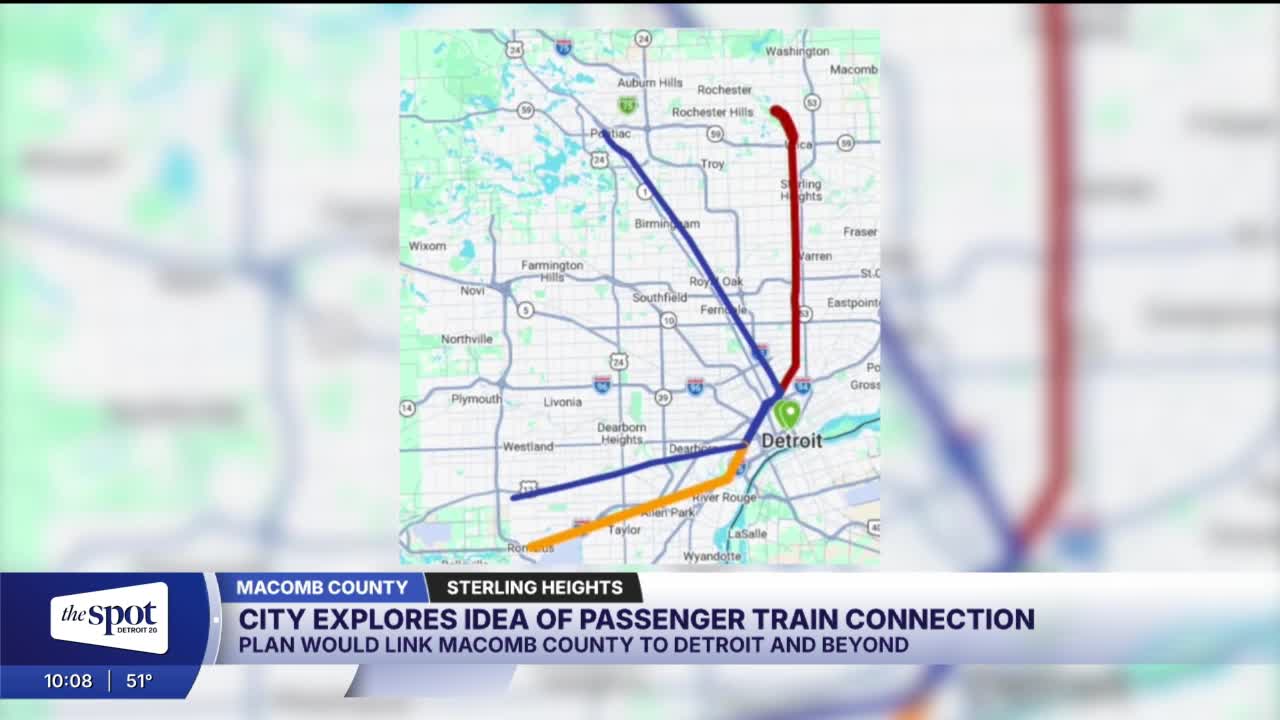

City leaders are racing against time to explore whether an existing 26-mile manufacturing rail could carry commuters, sports fans, and travelers all the way to downtown Detroit — and beyond.
Right now, a 26-mile rail line runs through Sterling Heights — but it carries freight and factory parts, not people. City Manager Mark Vanderpool says that could change, and the clock is ticking.
As portions of that rail are actively being disassembled, Sterling Heights is pushing to study whether a passenger line could run from the northern suburbs all the way to downtown Detroit, with possible connections to the airport and Chicago via Amtrak. The window to act may be narrow — and city leaders know it.
- 26 — Miles of Existing Rail
- 6–12 — Months to Secure Study Funding
The case for passenger rail in Metro Detroit isn't new — but what makes the Sterling Heights proposal different is the infrastructure already sitting in the ground. That 26-mile manufacturing rail isn't a dream or a rendering. It exists. The question is whether it can be repurposed before pieces of it disappear.
City Manager Mark Vanderpool described the moment bluntly: as sections of that rail are actively being disassembled, the urgency to act is growing. Missing this window, he said, would be negligent.
This could be an opportunity whose window will start closing over the ensuing years, and we certainly don't want that to happen. I think that would be negligent.Mark Vanderpool, City Manager
- 26 — Miles of Existing Rail — Currently serves manufacturing — not passengers
- 6–12 — Months — Target window to secure feasibility study funding
How the Sterling Heights Rail Proposal Takes Shape
- Now — Rail actively used for manufacturing — portions being disassembled
- Now — Mayor and City Council direct City Manager to explore passenger rail feasibility
- Next 6–12 months — City hopes to secure funding for formal feasibility study
- Study phase — Multi-city, multi-county, and transit organization coordination required
- Future — Possible routes: downtown Detroit, airport, Amtrak connection to Chicago
What would the rail actually connect? The current concept anchors on downtown Detroit — giving northern suburb residents a direct line for work commutes and major events like Lions games. But the vision extends further: a possible spur to the airport for travelers, and a connection to the existing Amtrak line that could place Chicago within reach.
None of that comes free or fast. Concrete costs, funding mechanisms, and routing details don't exist yet. What does exist is momentum — and a narrow window to act before the physical rail infrastructure that makes this possible is gone.
What the Rail Could Connect
| Destination | Current Best Option | Rail Possibility | |
|---|---|---|---|
| Downtown Detroit | Drive — no direct transit from Sterling Heights | Direct passenger rail along existing corridor | |
| Detroit Metro Airport | Drive or rideshare | Possible airport spur — included in concept | |
| Chicago | Drive (~5 hrs), Amtrak or fly | Potential Amtrak connection from the rail line | |
| Lions / Pistons games | Drive and park downtown | Rail directly to event venues — no parking needed |
Having no public transit anywhere in the area has always been a problem with Detroit. People that come here from out of town find it very difficult to get around because you have to know exactly where you're going at all times.David Rosseel, Warren resident
How Much Do You Know About This Rail Plan?
Four questions. The answers might surprise you.
The existing manufacturing rail that Sterling Heights wants to repurpose is how long?
- About 10 miles — The rail is significantly longer — it spans 26 miles. That's enough to connect Sterling Heights well into the heart of Metro Detroit.
- About 26 miles — Exactly right. The 26-mile rail currently serves manufacturing — the question is whether it can be converted for passengers before portions of it are torn up.
- About 40 miles — The existing rail runs 26 miles — substantial, but not quite that far. City leaders are racing to act before sections are permanently removed.
- About 5 miles — The corridor is much longer — 26 miles. Its length is part of what makes the opportunity significant, connecting northern Macomb County all the way toward downtown.
Why are Sterling Heights officials treating this as urgent right now?
- A competing city announced a similar plan first — No competing plan drove the urgency. The issue is physical — portions of the existing manufacturing rail are actively being disassembled, closing the window to repurpose it.
- Portions of the existing rail are already being torn up — That's exactly it. As sections of the rail are actively removed, the infrastructure needed to make a passenger line possible disappears with them. City Manager Vanderpool called missing this window 'negligent.'
- Federal rail funding expires at the end of the year — No specific federal funding deadline is cited in the city's rationale. The urgency comes from the physical rail itself — parts are being removed right now, shrinking what could be repurposed.
- A new city council majority is pushing the issue — The Mayor and City Council did direct City Manager Vanderpool to explore the concept — but the urgency isn't political. It's physical: parts of the rail are being dismantled as the city studies options.
Beyond downtown Detroit, what long-distance connection is included in the rail concept?
- Cleveland via Lake Erie — Cleveland isn't part of the proposed connections. The long-distance possibility in the current concept is a link to the existing Amtrak line that could reach Chicago.
- Chicago via the existing Amtrak line — Right. The proposal includes a possible connection to the Amtrak line already running through the region — which would put Chicago within reach from Sterling Heights without a car or flight.
- Ann Arbor via a new corridor — Ann Arbor isn't named in the current concept. The plan points toward a Chicago connection through the existing Amtrak infrastructure — no new corridor required for that link.
- Toledo via I-75 rail — Toledo isn't part of the proposal. The long-distance angle in the concept is a Chicago connection leveraging the Amtrak line that already runs through the region.
Within what timeframe does Sterling Heights hope to secure funding for a feasibility study?
- The next 30 days — The city's target window is broader — 6 to 12 months to secure funding for the feasibility study. The groundwork is still being laid.
- The next 6 to 12 months — Correct. City leaders are aiming to lock in feasibility study funding within the next 6 to 12 months — a near-term goal that reflects how seriously they're taking the opportunity.
- The next 5 years — The city's target is much sooner — 6 to 12 months just to secure funding for a feasibility study. The actual project would take years beyond that, but the study funding push is happening now.
- No timeline has been set — A timeline does exist. City Manager Vanderpool said the goal is to secure feasibility study funding within the next 6 to 12 months — a concrete near-term benchmark.
That urgency residents feel — the kind captured in a Sterling Heights man saying the train 'would be overloaded' with riders — reflects a long-running frustration across Metro Detroit. Visitors and newcomers frequently cite the region's lack of public transit as its most glaring infrastructure gap. Getting anywhere requires knowing exactly where you're going and having a car to get there.
City Manager Vanderpool is framing the rail not just as a transit project, but as an economic one. His argument: the region's next chapter of prosperity depends on connecting people to opportunity without requiring them to drive.
We believe that this is the next phase to prosperity. Not only for our city, but for the region.Mark Vanderpool, City Manager
What Would It Actually Take to Make This Happen?
The proposal is still in its earliest stages — no costs, no routing decisions, and no funding sources have been confirmed. What Sterling Heights is pursuing right now is a feasibility study: a formal analysis of whether passenger rail is viable on this corridor, what it would cost, and who would need to be involved.
Any real plan would require coordination with neighboring cities, Macomb County, state transit authorities, and organizations like Amtrak. That multi-party process is standard for regional infrastructure — but it also means no single city can move this forward alone.
The city's first concrete goal is straightforward: secure funding for that feasibility study within 6 to 12 months. Everything else — routing, stations, costs, timeline — follows from that study.
The Sterling Heights rail proposal is early-stage by any measure — but what it represents is rare: a chance to build regional transit on infrastructure that already exists, rather than starting from zero. The 26-mile manufacturing corridor is already there. The Amtrak line is already there. What's missing is a plan, a study, and the political will to act before the physical opportunity closes.
Whether that window stays open long enough depends on how quickly cities, counties, and transit organizations across Metro Detroit are willing to come to the table — a challenge Vanderpool acknowledged directly when he said 'the ingredients are here.'
Stay Informed on the Sterling Heights Rail Proposal
- Follow Progress at Sterling Heights City Hall: City leaders are actively researching the feasibility of passenger rail on the existing 26-mile corridor. Watch for updates from the Mayor's office and City Council.
- Key Connections Being Explored: Downtown Detroit for commuters and events, a possible airport connection, and a link to the existing Amtrak line toward Chicago — all part of the initial concept.
- Feasibility Study Funding: 6–12 Month Goal: The city's near-term benchmark is securing funding for a formal feasibility study. That study would determine costs, routing, and partners needed to move forward.
