



(WXYZ) — Tempted by promises of efficiency, a small but growing number of Michigan police departments have turned to artificial intelligence to help officers write police reports.
The new technology, pitched as a time-saving tool for strapped departments, is being embraced by a handful of chiefs or sheriffs who say it allows officers more time to respond to possible crimes.
But other chiefs are viewing the tool with skepticism, with some objecting to it outright.
“I want (officers) to own the report and be able to articulate from their own recollection of what happened and not depend on AI,” said Southfield Police Chief Elvin Barren.
As prosecutors navigate potential challenges posed by the technology, Wayne County Prosecutor Kym Worthy is urging departments “to be cautious and restrained” in their use of it.
Dearborn Heights became one of the earliest adopters of the technology earlier this year. Use of the program is not mandatory, according to Captain Jake Hatten.
“It’s still the officer's report,” he said. “It’s not AI’s report, it’s the officer’s report.”
Police reports have long been a critical tool in law enforcement, with the summaries often shaping the outcome of a criminal case. But officers have long been frustrated by having to spend sometimes hours each shift writing them, rather than being on the street.
“If I can cut down on the time that an officer writes a report or spends writing a report—I can get them back into the community—to me, that’s a bonus,” Hatten said.
While multiple companies offer different versions of the technology, the most popular is Draft One created by Axon—the same company that makes police body cameras.
The technology works by transcribing conversations recorded on body cams to produce an AI-generated summary. Officers are expected to take over from there.
“They have the ability to edit it, take stuff out, add information to it,” Hatten said, noting there are “built-in safeguards.”
Draft One inserts deliberate errors that officers are instructed to search out and remove.
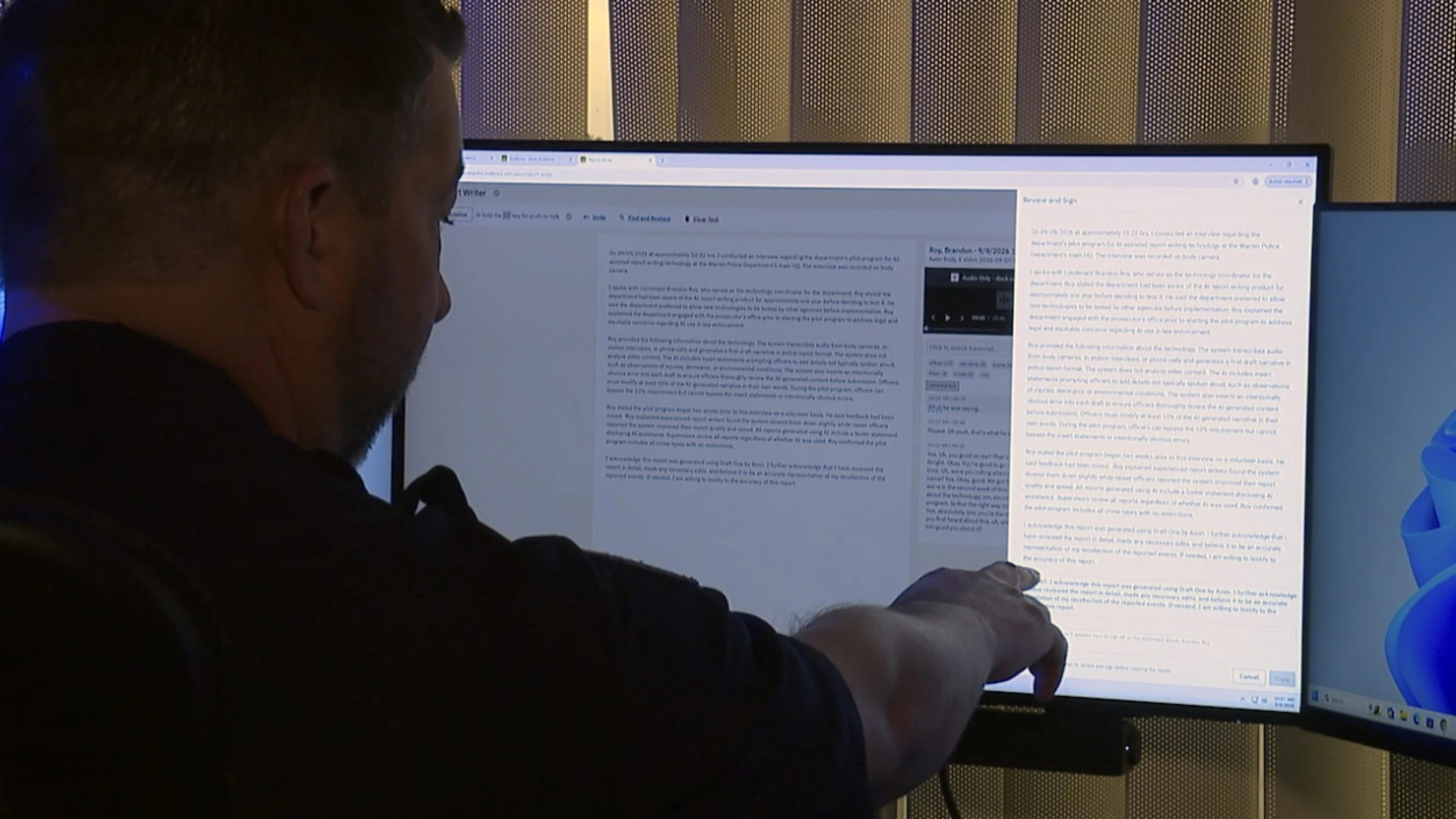
7 News Detroit watched a demonstration with Warren Police, whose officers have been using Draft One since August as part of a 60-day pilot program to determine whether they'll purchase it.
The technology inserts an obvious error—known to some officers as “Easter eggs”—saying that the “primary suspect was absolved by presenting a convincing alibi involving a time loop.”
Officers are expected to locate and delete the error, along with a handful of others.
“This is making it easier for them to do the work,” said Warren Police Commissioner Eric Hawkins. “But they actually have to do the work and they have to be accountable for what’s being done."
While the technology’s biggest appeal is the allure of time savings, recent studies have called those claims into question.
A study conducted by the University of South Carolina found that, while Draft One produces reports quickly, officers still had to spend time verifying the summaries and correcting mistakes.
“It didn’t actually save officers any time on their reports,” said Ian Adams, an associate processor who led the study.
Humans are still expected to be actively involved in writing each report. But in Warren, officers are only required to write 10% of each report’s narrative, meaning that the vast majority can be written by artificial intelligence.
“It seems like AI is writing most of the report, and then the officer is then reviewing the report," said Channel 7’s Ross Jones, "but AI did the bulk of the writing."
“I think that’s a fair statement,” said Commissioner Hawkins. “But then on the other hand, whatever is presented to them through AI, the officers have to attest that this represents their perspective on what happened.”
In another study conducted by the University of South Carolina, researchers compared the quality of officer-authored reports to those generated with the help of artificial intelligence.
It found that while the AI reports used words written at a higher grade level, they were rated “substantively and significantly lower on accuracy” than those written by officers.
“I did not know about that,” said Commissioner Hawkins. “But just hearing about that, yeah of course that causes me concern. And again, that’s one of the reasons why I want this pilot program right now.”
Adams, the USC professor, urged caution for departments using the technology today.
“The consequences of a bad decision in policing can be pretty profound, and obviously has impacts for the constitutional rights,” he said. “It’s better to proceed slowly here because the consequences in policing are so significant.”
About three weeks into its 60-day pilot program, Commissioner Hawkins described the results so far as “mixed.”
“We’re seeing some officers who are very, very skilled in writing reports that aren’t seeing much benefit from this,” he said. “We’re seeing some officers who may have lesser skills to writing reports who are seeing huge benefits.”
In Warren and Dearborn Heights, officers can use AI to generate reports on any crimes.
But some agencies, like the Kent County Sheriff’s Office, limit its use to just non-violent offenses. Undersheriff Bryan Muir said prosecutors have welcomed the technology.
“They’ve actually commented they like to see the AI reports,” he said. “They typically are more thorough, more comprehensive than some of the typed reports our officers are providing.”
In other states, prosecutors have hit the brakes. In King County in Washington state, prosecutors won’t accept cases where reports were written with AI. In all of Connecticut, AI assisted reports are on pause over concerns about accuracy.
In Wayne County, Prosecutor Kym Worthy is currently writing a policy for all police and public safety departments countywide that she expects will be complete in a few weeks.
On Tuesday, Worthy sent a letter to all police chiefs countywide saying that while her office "recognizes that AI can be a useful research tool...under no circumstances should AI be used without thoroughly checking and double-checking its authenticity."
Worthy said "using AI to generate police reports is an area fraught with problems because the AI may be incorrect, or contain errors that will jeopardize cases that we are prosecuting."
In the Macomb County prosecutor’s office, spokesperson Esther Wolfe said their office is “not imposing a one-size-fits-all policy on police departments. But we are asking police agencies to talk with us before implementing these tools so we can discuss the benefits, challenges and appropriate safeguards.”
“Those safeguards include clearly identifying AI-assisted reports, requiring meaningful officer editing and review, testing officers with intentionally obvious errors, supervisory approval and other checks and balances.”
In Oakland County, individual police departments are responsible for generating their own guidelines.
“With every police report, our position is that each officer authoring a report is responsible for the veracity of its content and must be prepared to testify under oath about its content,” said Chief Assistant Prosecutor David Williams.
Locally, most departments say they’re in no a hurry to adopt the technology.
Southfield Police Chief Elvin Barren says there’s good reason not to.
“We’re in the business of producing future leaders. So I want competent leaders who are comfortable with writing, comfortable with expressing themselves and not—over a period of time—allowing a system or AI to replace those skills,” he said.
Axon did not respond to repeated requests for comment for this story.
Contact 7 Investigator Ross Jones at ross.jones@wxyz.com or at (248) 827-9466.