

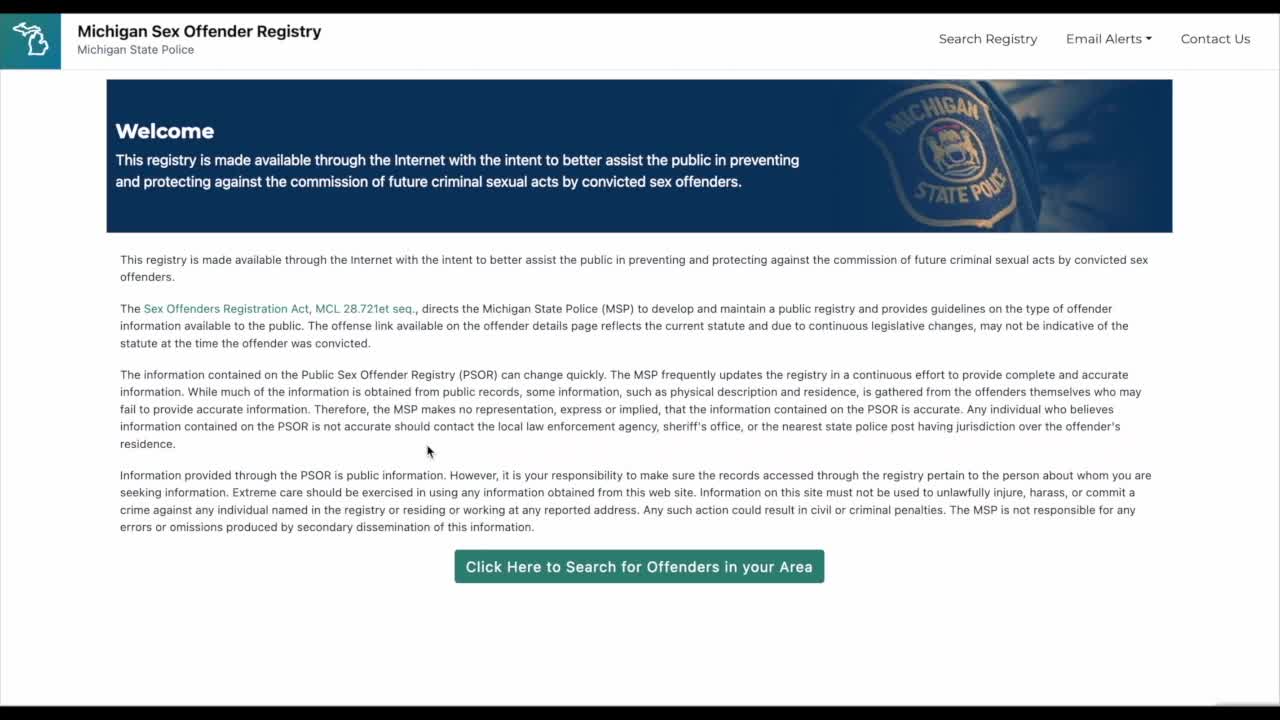


(WXYZ) — A recent Michigan Supreme Court ruling has led to the removal of more than 20,000 people from the state's sex offender registry.
In September, the Michigan Supreme Court ruled the state could not retroactively apply newer sex offender registration requirements to people who committed crimes before July 1, 2011.
As a result, approximately 20,000 names were removed from Michigan's Sex Offender Registry.
Watch Tiarra Braddock's story in the video player below:
For some Michigan residents, the decision raises questions about accountability and access to information.
"I used to subscribe to the list and I paid attention to the addresses," said Lucendia Halliday, a parent visiting her daughter in Ann Arbor.
Halliday said she was shocked to learn thousands of names had been removed from the registry.
"It's really sad," she said.
The ruling has also drawn criticism from survivors of sexual assault.
Swartz Creek resident Krystle Steele, who survived a sexual assault in 1998 when she was 10 years old, said the decision feels like a setback for victims.
"It feels like a kick in the chest for victims and it's just a huge safety hazard. I can't even believe this is happening," Steele said.
Steele recalled the attack that occurred when she was a child.
"This guy pulled up in his vehicle, he ripped me off my bike, took me to his Swartz Creek home, which is just a few minutes from the home I live in now. He sexually assaulted me multiple times," she said.
Steele said the man convicted in her case was released from prison six years ago. Because the crime occurred before 2011, she said his name, address and employment information were removed from the registry following the court's decision.
"The people who are supposed to protect us, the people who are supposed to have our back, the people who are supposed to believe us, here they are taking away our safety net," Steele said.
She added that the removal of information from the registry makes it more difficult for people researching neighborhoods and communities.
"If someone is buying a home, they can't check to see who's living in their backyard," she said.
Adam Wright, a former federal prosecutor and professor at Wayne State University Law School, said those whose names were removed from the registry remain convicted offenders.
"These individuals are still guilty of the original offense they were convicted of at the time that the jury or the judge heard the claim from the government," Wright said. "The only thing that changes is the registration requirement that was imposed after that conviction."
Meanwhile, Steele is organizing a rally in Lansing to protest the court's decision and push for changes.
"Something's got to change. This is not OK," she said.
