



DETROIT (WXYZ) — With midterm elections just weeks away, some Michigan voters are turning to AI to research candidates ahead of Nov. 3.
A new national study by the American Association of Political Consultants Foundation found 20% of AI users turned to the technology for political issues, elections or voting. ChatGPT and Google Gemini are the most commonly used AI tools among voters, according to the study.
Eighteen-year-old Wayne State University student Shealon Robinson is among those turning to AI to sort fact from campaign noise.
"I feel like there's a lot of misinformation with propaganda on ads on TV like YouTube... And I want to like further understand is that true?" Robinson said. "If I have a question about the person, I just go to Google."
Watch Faraz Javed's video report below:
Oakland University political science professor Nicole Mathew says when it comes to political research, where the information comes from matters.
"It could be a good place to start, especially if you ask the AI to identify its sources and then you can follow up by looking at the actual sources that the AI is using," Mathew said.
Mathew also raised concerns about whether AI can be trusted for political research.
"That's part of the problem is we don't really know what's inside that black box of how it's deciding what to tell you. And I think people have a fear that while these AI companies, they have a lot of business before the government, so what if they're trying to steer people in a particular direction," Mathew said.
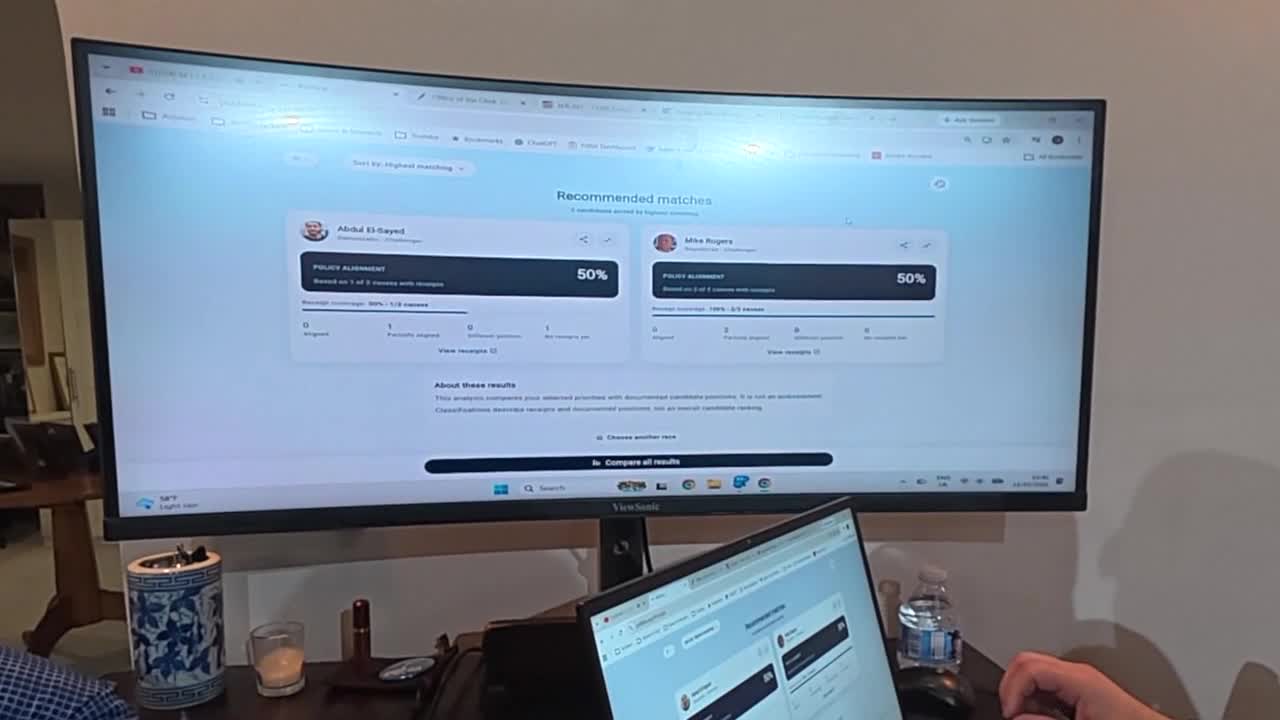
Joshua Feinstein is the co-creator of Polifine.org, a new AI-powered platform built for Michigan voters. The goal of the nonpartisan website is to cut through the campaign noise.
"With so much money being spent on this election and people just getting tons of information and information, we are not looking to persuade either anyway, and within two, three minutes, find out again, does this candidate align with my values? When they say they align with my values, what have they actually done? Not what they've said." Feinstein said.
Students say two of the biggest races they will be watching closely are Abdul El-Sayed and Mike Rogers for the U.S. Senate seat, and Jocelyn Benson and John James for governor.
Not all young voters are ready to let AI guide their ballot choices. Wayne State student Zachary Wick said he would not use AI tools to help make his decision.
"AI has been known to mislead and give false answers," Wick said.
Wayne State student Brooklynn Anderson agreed.
"I personally wouldn't use it," Anderson said.
Wayne State student Dominic Said sees potential in the technology.
"I think this AI tool will be a benefit to help people find where their vote should go and what they stand for." Said said.
Feinstein remains optimistic about the role AI could play.
"I think most of us hopefully will fall into the camp of using AI as a very advanced tool to help us with things that are important." Feinstein said.
For voters who prefer to avoid AI, Mathew recommends turning to local journalism.
"A lot of local newspapers, local TV stations cover these local races that you might not know as much about compared to the Senate race or the governor's race. So that's a great place to turn to," Mathew said.
Robinson encouraged young voters to stay engaged.
"Now's the time to really get active and understand what's going on, because it has an impact on us." Robinson said.
—————
This story was reported on-air by a journalist and has been converted to this platform with the assistance of AI. Our editorial team verifies all reporting on all platforms for fairness and accuracy.
