

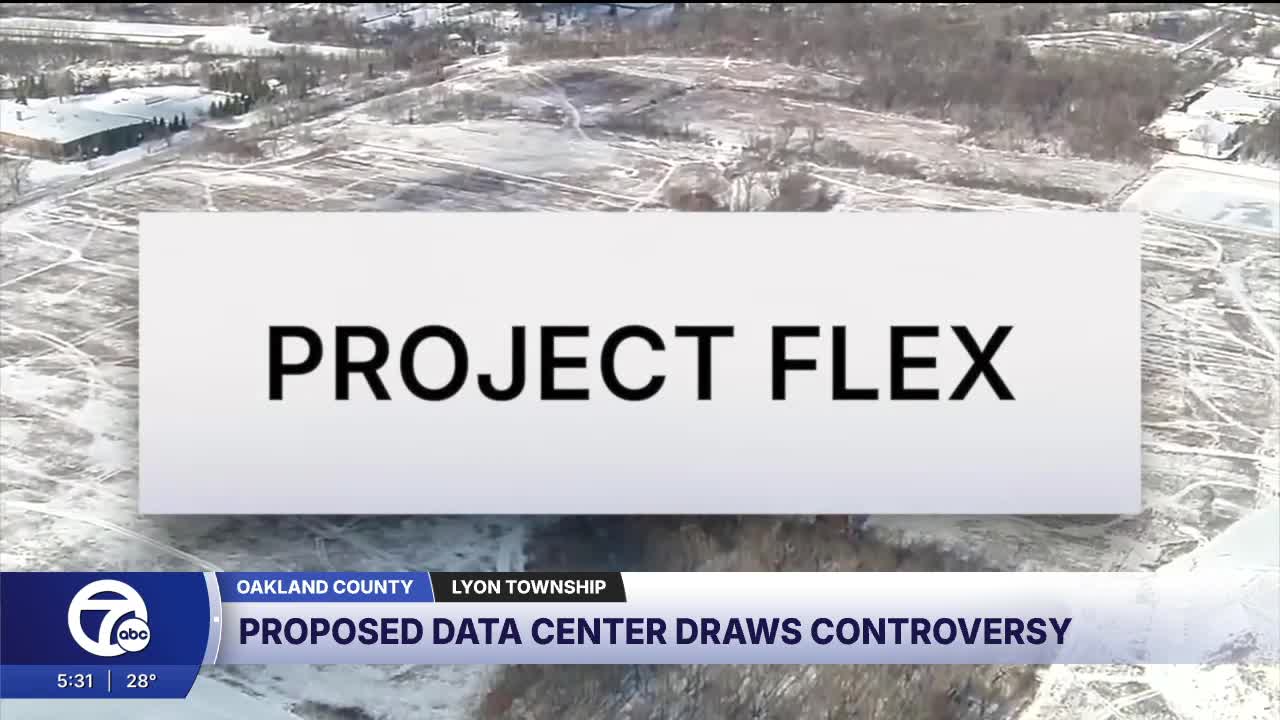


LYON TOWNSHIP, Mich. (WXYZ) — Residents in Lyon Township say they were blindsided by the approval of a massive data center project, claiming local officials failed to notify the public about the development that could transform 172 acres near their homes.
Watch Christiana Ford's video report:
The controversy centers around "Project Flex", a six-building data center complex proposed by California-based company Verrus. The project was conditionally approved by the township's planning commission in September, but many residents say they only learned about it recently through neighbors and social media posts.
"A neighbor notified all the neighbors, and then we've been finding out piecemeal on Facebook as well, which is unfortunate," said Kimberly Killian, who lives nearby.

The industrial zone sits just 300 feet from their residential zone, making Killian and her neighbors among the closest residents to the proposed facility.
"I'm extremely upset, I'm heartbroken, nobody wants that in their backyard," Killian said.
Planning commission documents show Verrus submitted a site plan application on August 7, which the commission approved on September 8 with conditions. The approval process happened without public hearings, as data centers are permitted uses in industrial zones under township regulations. The planning commission is not made up of elected officials but appointed.
Mike Kazy, who serves on the Downtown Development Authority board, discovered the project through his official role and took it upon himself to inform neighbors.
"I felt that was my obligation, my first step was to notify my neighbors so they knew, and things have kind of picked up from there," Kazy said.

Community members have since flooded social media with questions and concerns about the project, particularly regarding its potential impact on water resources, electricity infrastructure, and property values.
"Everyone understands, and living in this community, there's developments popping up everywhere. Right, you can't restrict somebody's ability to sell their property. I think everyone understands that. I think the biggest frustration here is nobody knew anything about it," Kazy said.
When contacted for comment, township officials declined an on-camera interview but later issued a press release.
The statement explained that data processing and computer centers are allowed in the I-1 light and I-2 general industrial zones without requiring public hearings or board votes, and noted that township proposals and documents are available online for public viewing.
RELATED STORY: Saline Twp. data center proposal sparks fears over energy costs and transparency
The response did little to satisfy concerned residents.
"It answered no questions, and it basically told me we don't care what you guys think," Killian said.
Kazy says he knows many leaders care about the community, but takes issue with how the information was communicated.
"I understand that they're saying be involved, show up to every meeting, that's not realistic for everybody, and that's why we have representation," he said.
We reached out to Vladimir Dvorkin, Assistant Professor of Electrical Engineering and Computer Science at the University of Michigan, for an engineer's perspective on the site plan. According to the website, Verrus says its system is to help data centers, big buildings full of computers, use electricity in a smarter way, combining micro-grids powered by advanced, high-capacity batteries with intelligent software to allocate energy optimally.
"We have a preliminary results we're bound to publish where we actually show what is the value of energy storage in distribution systems for smoothing the impacts of data systems and what our results show that this technology is so fast enough and it can be optimized so efficiently that residential, commercial and all other customers will see almost no impact on distribution system operations, on power quality, provided that there is a right amount of energy storage units placed on site," said Dvorkin. "So it is indeed possible, but as we all say, Devil is in the details. We need to always make sure that we procure enough energy storage, that the software that we use is actually optimized, and it's fast to respond."
He expressed optimism about the technology involved, despite some concerns about water and electricity used, water for cooling, and electricity for computations.
“As engineers, we’re very hopeful. We know how to control this technology, and we are very optimistic. These data centers can bring solutions that make everything sustainable,” said Dvorkin.
He emphasized potential benefits for the township, county, and state with smart design.
"Data centers might seem like a strain on communities, but because of their commitments to decarbonization, we might see a lot of innovation like new sites for solar generation and energy storage that will significantly enhance our grid infrastructure," said Dvorkin.
The project cannot move forward until Verrus submits updated plans addressing all conditions set by the planning commission, including completion of a sound study. The company has not yet provided those updated documents.
Once the township finalizes approval, the plans will be valid for 2 years, until September 8, 2027.
The township says once the final site plans have been submitted for review, the applicant must apply for a detailed engineering review, and the applicant will have to receive approvals from all applicable agencies (Drain Commission, EGLE, etc.) prior to commencing construction.
Once pre-construction requirements have been met, the development team can schedule a pre-construction meeting and, thereafter, commence construction
The Lyon Township controversy follows a similar situation in Washington Township, where residents packed a township hall meeting to voice opposition to another proposed AI data center development.
PREVIOUS COVERAGE: Macomb County residents pack zoning meeting to oppose proposed data center
—————————————————
This story was reported on-air by a journalist and has been converted to this platform with the assistance of AI. Our editorial team verifies all reporting on all platforms for fairness and accuracy.
