

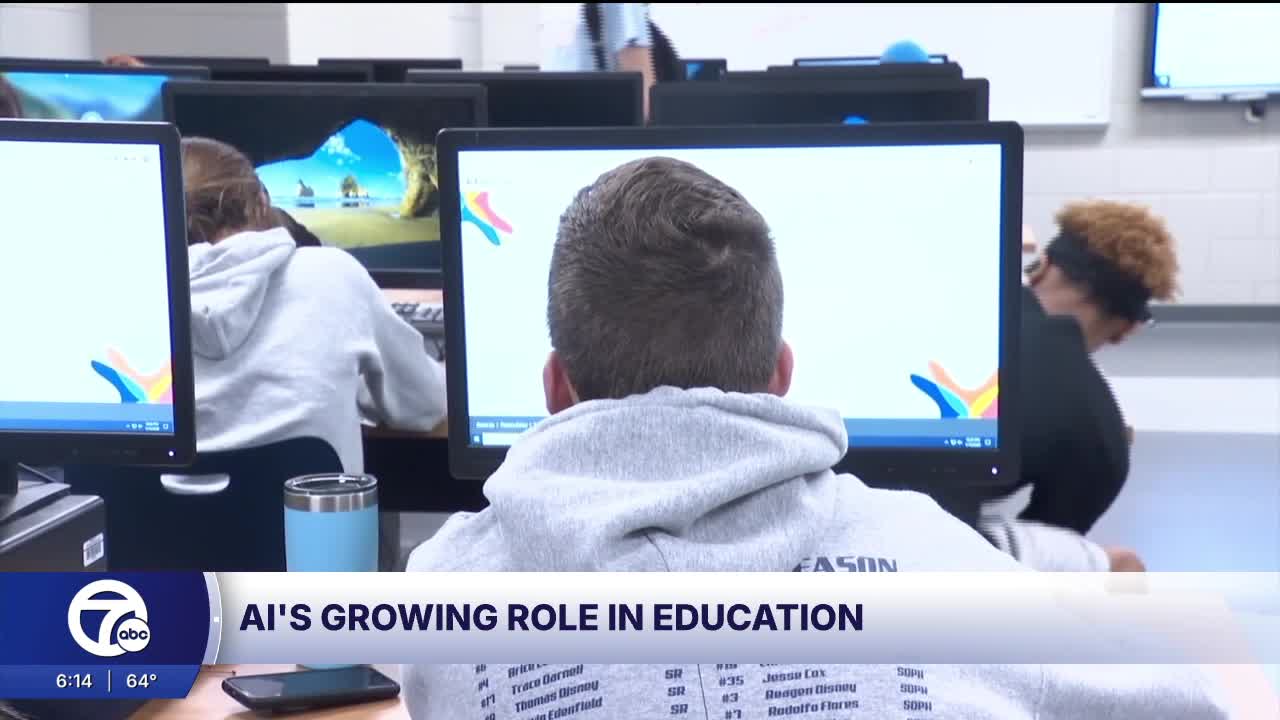



(WXYZ) — Across metro Detroit, more and more school districts are embracing how learning can be furthered through the use of artificial intelligence.
Watch Simon Shaykhet's video report:
When it comes to using AI in education, students, parents and teachers are telling me there's a lot of thought that goes into how to use the technology responsibly.
“Talk to me about your experience with AI, right now," I asked Ridham Kadbra, an 11th grader at Novi High School.
"Right now, I use two main platforms, Claude and Notebook LM," Ridham said.
Ridham is quick to admit how important a role AI has come to play as part of the learning process. For instance, in AP language and composition studies, he said programs help deliver more resources.
“You need to do a lot of thinking, contextualizing, synthesizing. You need to have the ability to really develop a thesis," he said.

But, Kadbra points out that the key part of embracing AI in the classroom is centered around not relying too heavily on a program to do the work, but rather using its tools to help process an assignment, and always verifying what information AI is providing.
“I asked it something about microeconomics, a class I am taking right now, and it just said something completely untrue," he told me. "I caught it because I had that previous knowledge.”
Kadbra said he's often thinking about how a future career will leverage AI. That's a question teachers in Detroit are also devoting considerable thought to.
I wanted to gain a better understanding of the role of AI in specific courses taught at Detroit Public Schools Community District under the watch of Tanisha Bronaugh and Michael Hanson.
“AI is a very good support system for skilled trades overall. For every trade in our building," Bronaugh said.
Bronaugh said that at Breithaupt Career & Technical Center, kids are learning graphics, editing, printing, planning and more. She also said it cuts down on the time needed to conduct training for nearly 500 students in 6th grade and up.

“We currently have seven programs. Our largest program is our culinary wing. So, one half of our building is dedicated to culinary arts, all different types," Bronaugh said. “We have a megatronics lab that has beautiful, big robot arms inside of it. Great for our engineering students. Next, we have our salon, and the salon is full-blown cosmetology.”
She said AI programs are also enlisted in welding and automotive courses, but unlike other programs, AI is not taking the place of teachers.
One instance I found is in the Chicago area, where a school is fully run by AI. I reached out to them for an interview, but haven't heard back.
A recent study from Youngstown University also shows how AI dedication has grown rapidly. The student found it was used in 60% of K-12 public schools in the U.S. in the 2024-25 school year, with 32% of teachers using it at least weekly. The study said that usage was highest among 11th and 12th graders at 31%.
“We do know skilled trades is powerful, because it’s one of the things that AI will not be able to take your job. Right? But, AI can definitely assist us in streamlining our programs, and just making that production time a lot faster," Hanson said.

While popular programs like ChatGPT are commonplace, Breithaupt School has used advanced technology for about three years.
“It’s not going away, so we do have to embrace it," Kirsten Douglass, a parent in West Bloomfield, said.
She also told us she's having conversations with her children about using AI.
“Like writing a paper, using the tool to help you gather your research. The hard part, I think, for some of the students, is understanding the biases for some of the AI," she said.
Whether it be fact-checking, turning to multiple sources or simply building a foundation of knowledge independent of AI. She and others I talked to are sending the message that the benefits of AI must be weighed carefully against the potential for reducing memory.
“Grabbing that information, but then double-checking, looking at the sources. Where is that information coming from?” Douglass said.
For Kadbra, it comes down to responsibly programming AI to perform a task, but not taking over assignments as a whole.
“Don’t give me the explicit answer, but help me get toward the answer by asking me more questions that clarify my thinking," he said.
In the Novi Community School District, a spokesperson says anything involving AI is being led by comprehensive guidance from the district.
