

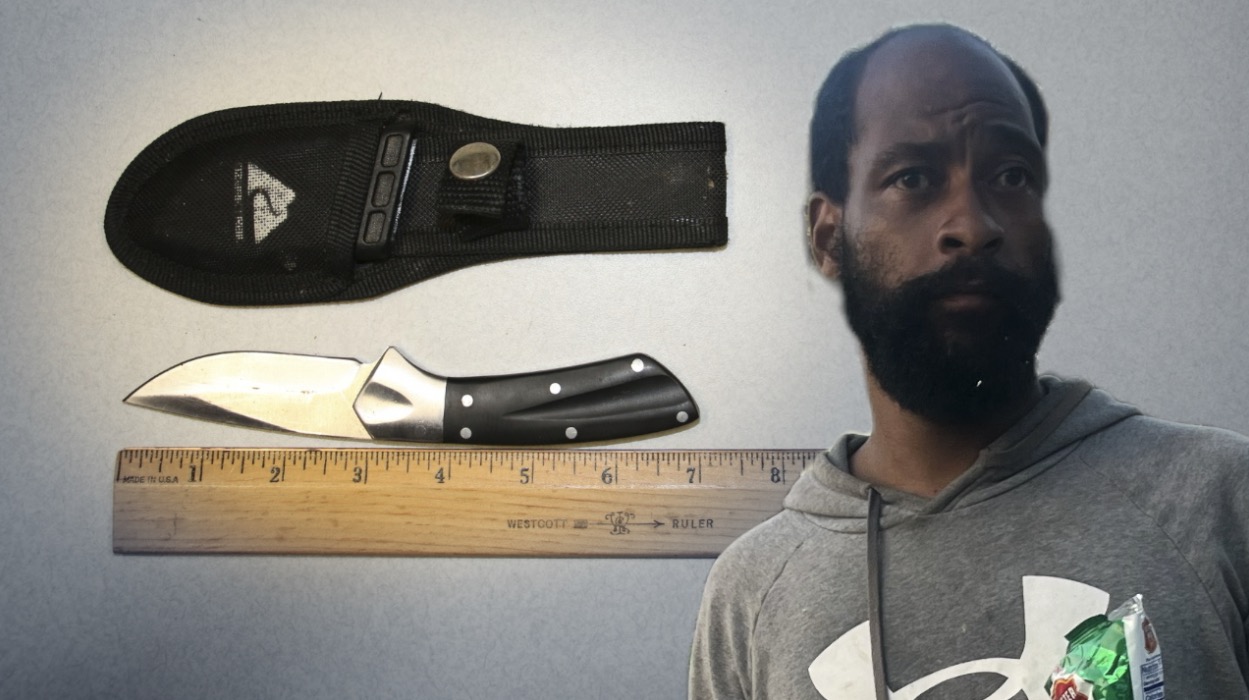


DETROIT (WXYZ) — Days after a woman would be stabbed to death in downtown Detroit—by a person, police said, who was under an order for mental health treatment—another disturbed man would surface just blocks away, armed with a knife.
Outside the Greyhound bus station on Howard Street downtown, a caller told 911 that a man who “is very mentally ill” was terrifying people, making stabbing motions with a “humongous knife.”
“Move! Get away from him! Get away from him!” she could be heard screaming into the phone.
RELATED: Fatal Detroit stabbing exposes gaps in court-ordered mental health treatment
Detroit police responded quickly and confronted Travis Moultrie, eventually taking him into custody.
It was then they would learn he’d been ordered by a judge into psychiatric treatment just two weeks earlier.
To police departments across Saginaw County, Moultrie is a man they know well.
“I think of a lot of calls for service, a lot of concerned citizens, and really no good answers,” said Caleb Rowell, director of public safety for Bay City.
For years, officers there and throughout Saginaw County have watched Moultrie’s behavior escalate. They have responded to cries for help, threats of violence and encounters that sometimes turned confrontational.
Over the years, Rowell estimates his officers alone have encountered Moultrie—who is homeless— at least a hundred times.
Moultrie’s criminal history includes convictions for home invasion, weapons charges and assaulting, resisting or obstructing police.
Over the last six years, police reports document 36 different interactions with Travis, spanning four different agencies.
Twenty of the reports include allegations of threatening behavior, like Moultrie saying he “wants to kill everyone” or “that he is the devil.”
Twelve reports reference knives: steak knives, kitchen knives, folding knives and hunting knives that Moultrie is said to have used to threaten or intimidate.
Last year at a liquor store, Moultrie was seen on surveillance video pulling out a folding knife in the midst of an argument with a clerk.
“We’ve arrested him, we’ve petitioned him,” Director Rowell said. “But he’s still back out on the street, not really getting many services.”
Moultrie has been the subject of multiple mental health petitions seeking hospitalization, with police reports referencing at least five.
The most recent came in August, when an officer wrote that Travis was “making threats to people at local businesses” and “ran out into traffic.”
“Each year, it’s progressed to worse and worse,” said Rayshon Moultrie, Travis’s father. “This is the worst I’ve ever seen him, the stuff he does now.”
Travis’s mental health struggles have been compounded over the years, his father said, due to bouts with alcoholism.
“I don’t know what to do. I can’t help him,” he said. “I’ve been to so many different mental institutions with him. Nothing has worked.”
After being hospitalized in August, Travis was out by September. That month, police would be called again after a driver said Travis was punching his car outside a liquor store.
The responding officer noted he had encountered Travis “a crazy amount of times” and had petitioned him before, according to a police report.
On September 23, a Saginaw County probate judge ordered Travis hospitalized for up to 60 days.
Travis was out within two weeks.
While he was under a court order to receive assisted outpatient mental health treatment in Saginaw County, Travis was found in Wayne County on October 5, wielding a knife at the Greyhound bus station downtown.
“(He) was armed with a knife, was being hostile,” said Detroit Police Captain James Domine. “He allegedly had it up in the air and was swinging it around.”
Yet again, police would take Travis to a nearby hospital where he would be held until he was stabilized.
Earlier this week, his family said Travis was seen back on the streets of Saginaw.
Kevin Fischer, the president of the Michigan Chapter of the National Alliance on Mental Illness, says the needs of those with severe mental illness far outpace the resources that have been invested.
“We have a greater responsibility to say, ‘Maybe we need to take this a step further,’” Fischer said. “We are reactive to these situations rather than being proactive.”
The people who care about Travis Moultrie have pulled every lever the mental health system offers to get him help, and still, it hasn’t been enough.
Today, they wonder what it will take for something to finally change. They fear they already know.
“What do you do?” Rowell said. “There’s just not a system set up to deal with that until the unthinkable happens. And somebody gets killed or seriously injured.”
“And then,” he said, “something will happen.”
Contact 7 Investigator Ross Jones at ross.jones@wxyz.com or at (248) 827-9466.