

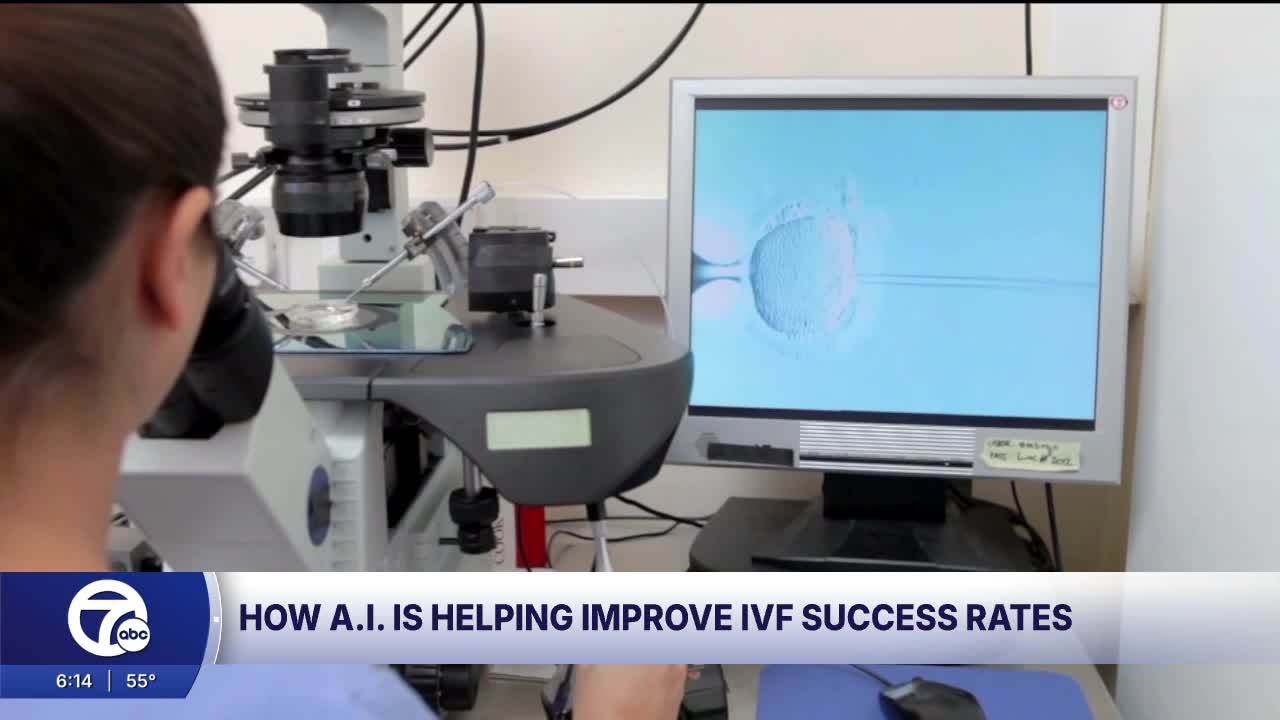


(WXYZ) — People are now using artificial intelligence in all aspects of life, and now, AI is helping new parents overcome infertility-related issues, helping hundreds of patients to have children.
One woman we spoke with is pursuing pregnancy with the help of IVF treatments and AI.
See the full story in the video below
For Robyn White, the decision to become a gestational surrogate was born from the belief that sharing the gift of motherhood is a calling.
“What made you want to carry a baby for a family who could not conceive?” I asked White.
“To me, it’s an act of sisterhood. Really. Not trying to be too mushy. We are women. There are certain things our bodies are supposed to be able to do. Every woman can’t carry a baby. I can," she said.
She's been working with an agency to help a family from New York, and she's also hoping to get pregnant herself with the help of IVF.
“With the power of AI, everything is precise, everything is clear. No confusion and results come quicker," White added.
She said her journey led her to the Michigan Fertility Institute in Livonia, a fertility clinic that incorporates AI into each step of the process.
I visited the laboratory where a highly trained embryologist conducts critical testing, and I also spoke with Dr. Ali Bazzi.
“Why is AI so needed in this field where you’ve been doing something like this previously in a different way?" I asked Bazzi.
"By incorporating AI, it may help make the process more efficient and may identify areas within the protocols we use for our patients that can be optimized, thereby increasing success," Bazzi said.
During my visit, I asked how AI technology is specifically improving outcomes.
“You can pretty much eliminate the chance of a baby having a disease," Bazzi said.
He said it also drives greater efficiency and reduces the likelihood of miscarriage or complications.
“We're incorporating a system in place that allows us to monitor the embryo every second of the day until it’s ready for biopsy," Bazzi said.
One embryo, just six days old, is now being analyzed with the help of an AI program, which also compares it to others like it.
"We can assess the grade of them. We give the embryo a grade, based upon, how does the mass that’s going to be the baby in the future, how does that look like and how does the outer layer of the embryo that’s going to be the future placenta look like?" he said.
A recent Princeton Medical Review article further highlights how AI is modernizing human-centered fields, including helping to address infertility.
Its ability to more accurately review tests is also amounting to a game changer, according to Oakland University Professor Tara Delecce.
“You could ultimately pinpoint, rather quickly, if this would be a good embryo or not. This is a good sperm sample," Delecce said.
“Actually allows us to watch the growth of the embryo in place in real time from the moment the sperm is injected into the egg, until this moment right here where our embryologist is taking a piece of tissue from the embryo, some cells to do a biopsy," Bazzi said. “It truly allows us to select the best embryo.”
Delecce adds that it can truly help make the difference between bringing a healthy baby into the world, or struggling for years to conceive, and the potential for human error is greatly reduced.
“We have an idea of what predictors will lead to more or less successful outcomes, but we can streamline the process. You can feed it a bunch of data, that’s at least the goal," Delecce said.
She said, beyond egg and embryo study, with male infertility as high as 40% in some cases, this technology can help in identifying viable sperm to help achieve pregnancy.
“There are still labs where they just take a little drop of the sample on a microscope slide, and just count manually. That’s their measure of sperm count. I’m just thinking that’s so subjective and prone to error,," Delecce said.
“Does there need to be more awareness this technology plays such a key role?" I asked White.
"Absolutely. You would think your options or care is limited, and it’s the polar opposite of that," she said.
At the Livonia facility, Bazzi says hundreds of pregnancies have been achieved with AI technology, a number that continues growing exponentially.
